The last words of Hugh Latimer, spoken through the flames of his own execution in 1555, are among the most famous and defiant ever uttered in the English language — a dying man’s promise that turned his own agonising death into a battle cry that changed a nation.
Hugh Latimer was an old man, born around 1485, and one of the most beloved preachers in all of England. He had risen to become Bishop of Worcester and a leading champion of the Protestant Reformation — the movement to break the English Church away from Rome. Under King Henry VIII and his Protestant son Edward VI, men like Latimer had helped remake England as a Protestant nation. His companion in death, Nicholas Ridley, was the brilliant Bishop of London, another of the great architects of the reformed English Church.
The Horror
But then the throne passed to Mary I — “Bloody Mary” — the devoutly Catholic daughter of Henry VIII, who was fiercely determined to drag England back to the Catholic faith of Rome. And she set about doing it with fire. During her short reign, she had nearly three hundred Protestants burned alive at the stake for heresy, in a campaign of terror that scarred the nation’s memory for centuries. Among her greatest targets were the leading Protestant bishops — the men who had built the Church she was tearing down. Latimer and Ridley were arrested, imprisoned, interrogated, and pressured relentlessly to recant their Protestant beliefs and return to Rome. They refused. Both men held firm to their faith, and both were condemned as obstinate, incurable heretics and sentenced to burn.
On the 16th of October 1555, after eighteen months of imprisonment, Hugh Latimer and Nicholas Ridley were led out to be burned together, at a single stake, on the north side of the city of Oxford, in the town ditch just outside the walls. A great crowd gathered to watch. In a deliberate act of cruelty and intimidation, a third condemned bishop — the Archbishop of Canterbury, Thomas Cranmer — was forced to watch the whole thing from the tower of his prison nearby, so he could see the fate that awaited him.
The two men were chained back-to-back to the same stake, with bundles of wood piled around their feet. They had prayed and talked together, comforting each other. Ridley spoke first to strengthen his friend, saying: “Be of good heart, brother, for God will either assuage the fury of the flame, or else strengthen us to abide it.” Ridley’s brother-in-law had brought them a small mercy — pouches of gunpowder, which were hung around their necks, so that when the flames reached them the powder would explode and end their suffering quickly.
Then the burning torch was brought and laid down at Ridley’s feet, and the fire began to rise.
And it was at that moment that Hugh Latimer, the old preacher, turned his head toward his friend and spoke the words that have echoed through five hundred years of English history. Raising his voice so Ridley could hear him over the crackling flames, he said:
“Be of good comfort, Master Ridley, and play the man. We shall this day light such a candle, by God’s grace, in England, as I trust shall never be put out.”
Play the man. Be brave. And know that our deaths are not an ending but an ignition — a candle lit in England that no one will ever be able to extinguish. It was one of the most magnificent acts of defiance in the face of death ever recorded: an eighty-year-old man, being burned alive, using his final breath not to scream or beg, but to comfort his friend and to declare, with total conviction, that his killers had already lost.
3️⃣ THE MODERN RELIC For Latimer himself, the end came mercifully fast. The flames rose quickly on his side, the gunpowder caught, and the old man died almost at once, reportedly bathing his hands in the fire as though washing them, and dying with little pain.
But for Nicholas Ridley, it was a horror. The wood on his side had been stacked badly — too high and too green, and it would not burn properly. The flames smouldered around his lower body, burning his legs terribly but never rising high enough to reach the gunpowder around his neck and grant him a quick death. Ridley suffered appallingly, in prolonged agony, crying out again and again the desperate words: “I cannot burn! I cannot burn! Lord have mercy upon me! Let the fire come unto me!” He was heard begging for the flames to rise and finish him. Finally, a bystander, moved to pity, reached in and pulled away some of the badly-stacked wood, letting the fire catch properly at last — the flames leapt up, the gunpowder finally ignited, and Ridley’s suffering ended.
And Latimer’s dying promise came true, exactly as he had spoken it. Their deaths, and the deaths of the roughly three hundred other Protestant martyrs, did not crush the Reformation in England — they gave it its martyrs, its heroes, and its unbreakable resolve. The horror of the burnings turned English public opinion permanently against Rome. Just three years after Latimer and Ridley died in the Oxford ditch, Mary I herself was dead, and her Protestant sister Elizabeth I came to the throne. England became a Protestant nation for good, and the “candle” Latimer had lit blazed up into a torch that has never been put out. Their story was immortalised in John Foxe’s Book of Martyrs, one of the most influential books in English history, read in churches and homes for centuries.
The relics are in the streets of Oxford, and they’re startlingly real. The exact spot where Latimer and Ridley burned is marked by a cross set into the road surface in Broad Street, right outside Balliol College. And it isn’t just a symbol — when workmen were digging there, they uncovered part of a charred wooden stake and fragments of burnt bone in what had once been the town ditch, the physical remains of that October morning. Nearby stands the grand Victorian Martyrs’ Memorial, a soaring stone monument raised in the 1840s to Latimer, Ridley, and Cranmer, so that the men who lit the candle would never be forgotten. You can stand on the cross in the road today, on the very ground where an old man being burned alive turned to his friend and told him to play the man, and lit a candle that still burns.
Nearby on the Dark Atlas
- The Candle That Would Never Be Put Out
Burned together for their faith, one died quickly while the other screamed in agony for nearly an hour.
Oxford, United Kingdom · 1555 · same site
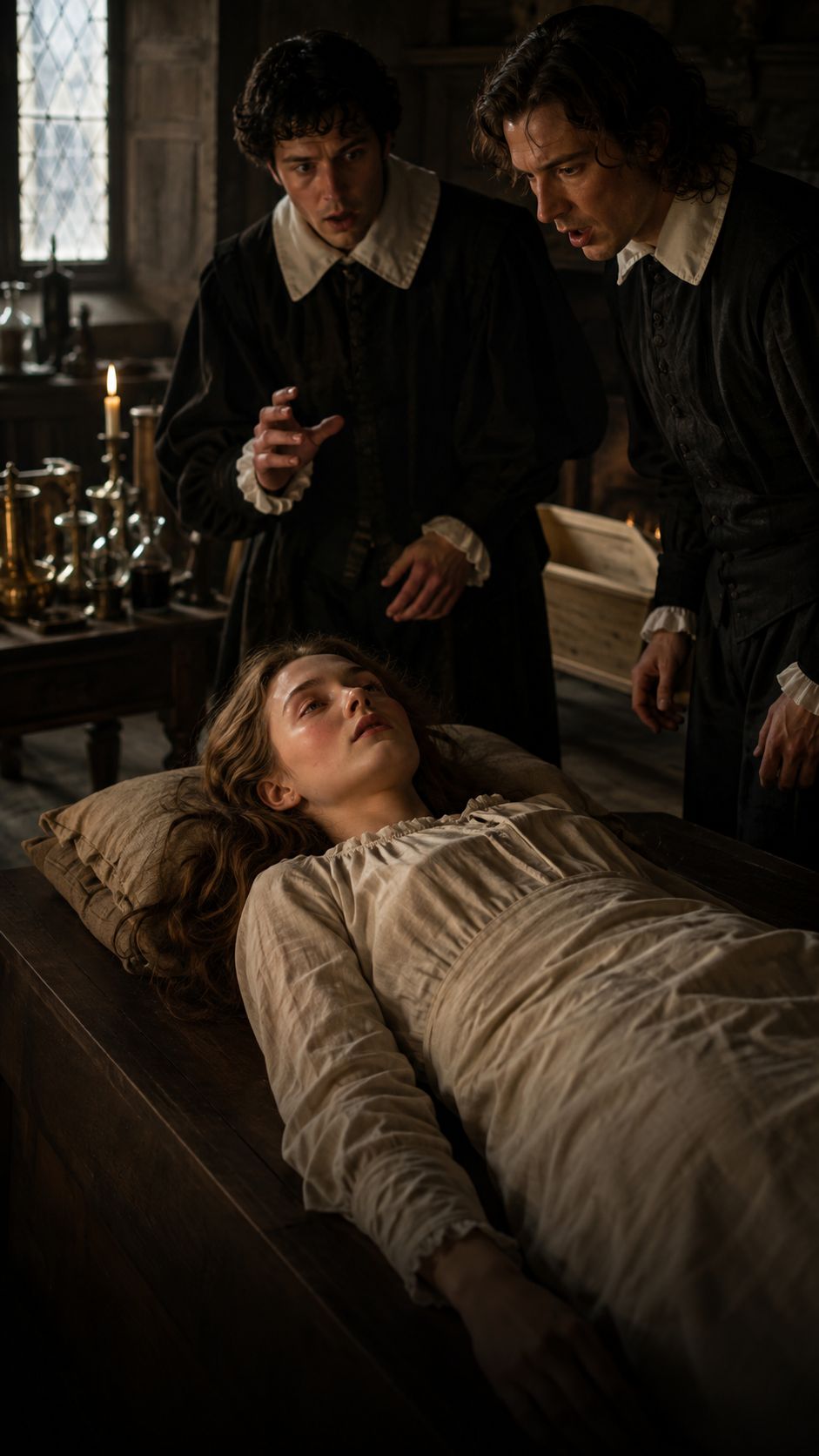 The Woman Who Woke Up In Her Own Coffin
Hanged, sealed in a coffin, and delivered to anatomists with knives ready, she was found alive when they opened the lid.
Oxford, United Kingdom · 1650 · same site
 The Empress Who Escaped Through The Snow
Trapped in a besieged castle, England's rightful heir was lowered by rope into a snowstorm in white and walked to freedom.
Oxford Castle, Oxford, United Kingdom · 1142 · same site
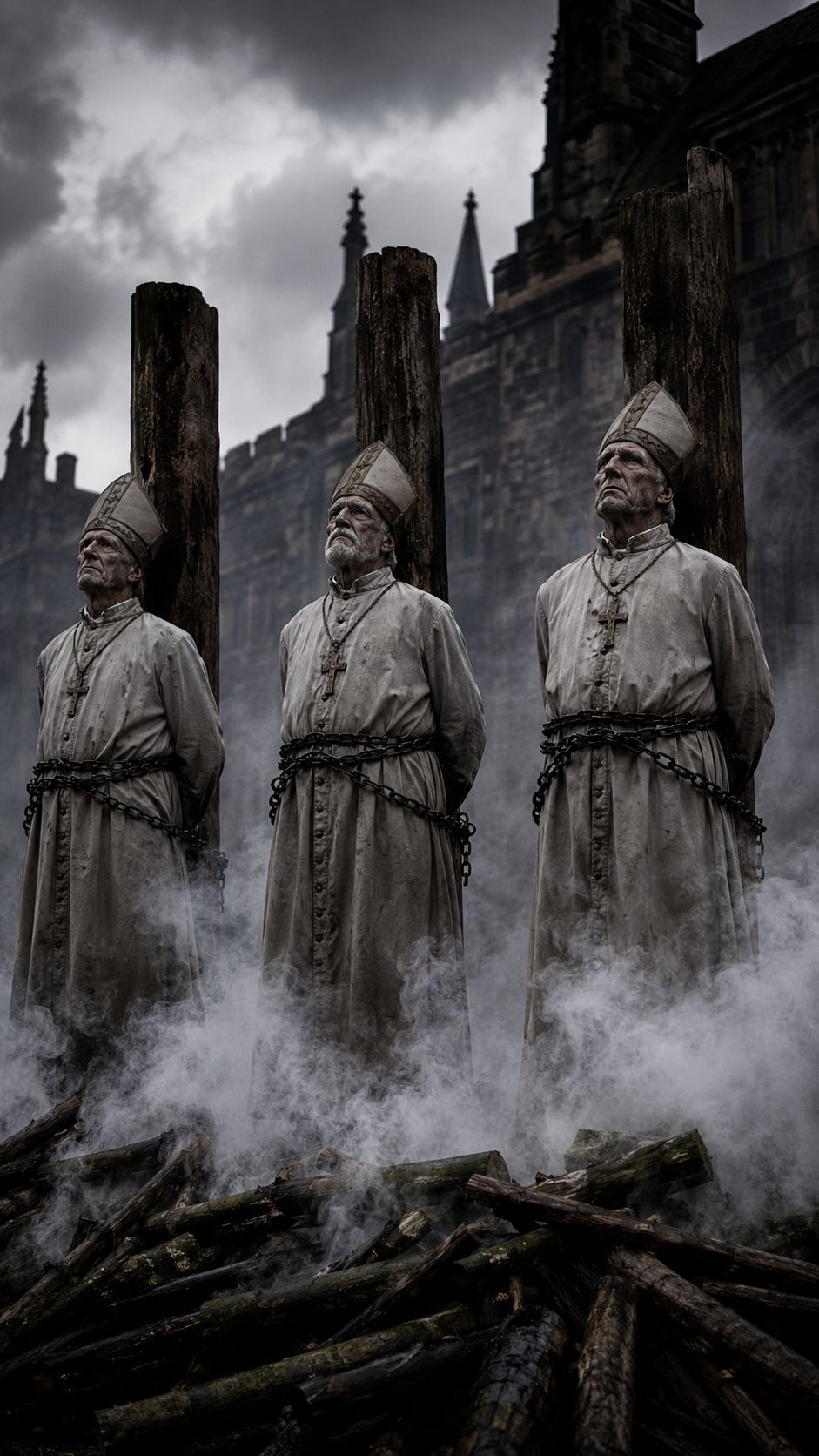 The Fires That Made Bloody Mary's Name
Three of England's highest churchmen were chained to stakes in the center of Oxford and burned before a watching crowd.
Oxford, United Kingdom · 1555 · same site