
On the morning of 15th June 1381, a fourteen‑year‑old king rode out to Smithfield to negotiate with the man who had just broken into the Tower of London, beheaded his Archbishop, and led the largest popular uprising in English history.
Richard II sat on a warhorse. Wat Tyler rode up on a pony. Tyler called the king “Brother” — a breach of protocol so shocking that chroniclers recorded it with visible disgust.
Tyler demanded the end of serfdom, the redistribution of Church wealth, and the right of every Englishman to hunt and fish freely. Richard appeared to listen. Then an argument broke out.
The Horror
In the confusion, the Lord Mayor of London, William Walworth, drew his sword and slashed Tyler across the head and neck. A royal squire — usually named as Ralph Standish or Ralph Stafford — thrust a dagger or sword into him repeatedly. Tyler managed to ride or stagger a short distance before he fell.
His followers — thousands of armed men, including longbowmen who had fought in France — saw their leader go down. They drew their bows. Arrows were nocked. For a moment, it looked as if every man in the king’s small party was about to die.
Richard II was fourteen. He had been king since he was ten. He had never fought a battle. He had never commanded troops in person. What he did next has never been fully explained.
He rode forward. Alone. Toward the mass of rebels.
According to the tradition recorded by Froissart and later writers, he called out: “You shall have no captain but me. Follow me.”
They followed him.
Richard turned his horse and led the rebel host away from Smithfield toward the fields near Clerkenwell, promising that their demands would be granted and that Tyler had been or would be honoured. Behind him, Walworth raced back into the City and raised a militia. By the time the rebels realised they had been outmanoeuvred, armed forces loyal to the crown were in control of London’s gates.
Tyler’s head went up on a spike on London Bridge that same day.
Within days, Richard revoked every charter and concession he had issued under pressure. Commissions of oyer and terminer hunted down the rebel leaders. When a delegation came to remind him of the promises he had made at Mile End and Smithfield, chroniclers report him replying: “Villeins you are, and villeins you shall remain.”
The boy who rode alone into thousands of armed men and talked them into following him instead of killing him was deposed in 1399 by his cousin Henry Bolingbroke. Richard was imprisoned at Pontefract Castle and probably starved to death in early 1400. He was thirty‑three.
The Modern Relic
Smithfield still exists — now a meat market at the edge of the City of London. The ground where Tyler fell is within a hundred metres of the place where heretics were burned, where the Carthusian monks of Charterhouse were hanged, drawn and quartered, and where Richard Roose was boiled alive. More judicial blood has soaked into that patch of London than almost anywhere else.
A memorial to Wat Tyler was finally put up in 2015 — a small plaque marking the site where he was cut down, 634 years after his death.
The dagger or short sword traditionally said to have killed Tyler appears on the coat of arms of the City of London: a red cross of St George with an upright sword in the upper left quarter. Later storytellers claimed the weapon was added to honour Walworth’s blow, and a 17th‑century ballad says the king “gave the dagger to the city arms.” Modern historians point out that the sword was already part of the arms earlier in 1381, probably as a symbol of St Paul’s martyrdom. The myth is what stuck.
So today, official City documents still carry a crest that many people believe shows the blade that killed the rebel. The market where he fell has a small plaque with his name. The boy who faced the mob has a contested tomb and a reputation as both saviour and betrayer. Smithfield kept the blood. The coat of arms kept the dagger. Nobody kept the promises.
Nearby on the Dark Atlas
- The Rebel Woman Burned for Treason
A law meant to spare women from the executioner's blade instead condemned her to the flames.
Smithfield, London, United Kingdom · 1537 · same site
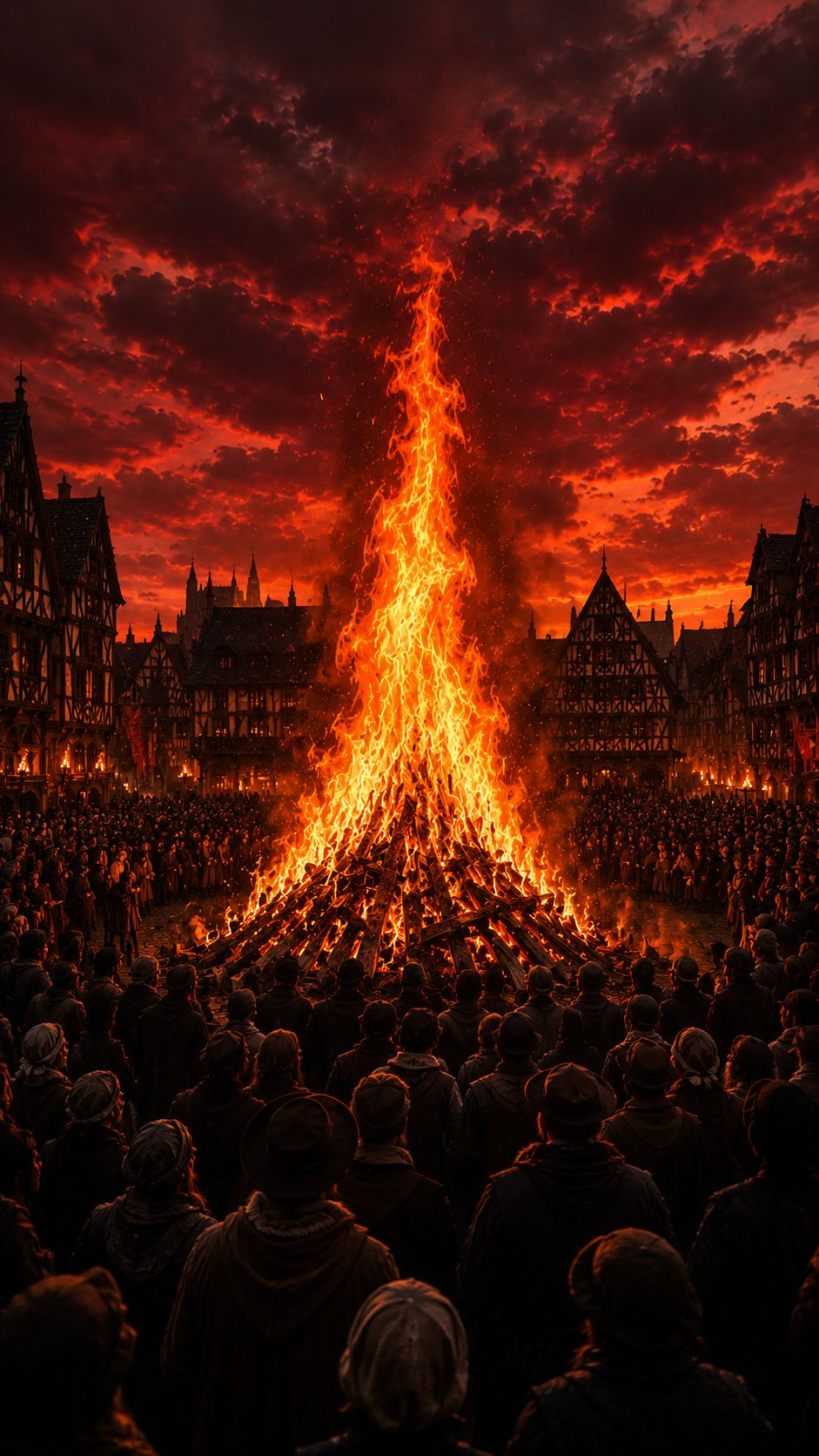 The Prophecy A Burning Friar Fulfilled
An old Welsh prophecy said a wooden saint would set a forest ablaze, and Henry VIII made it true by burning a friar on its statue.
Smithfield, London, United Kingdom · 1538 · same site
 The Slow Public Death Of Scotland's Guardian
Dragged naked through London on purpose, a rebel knight faced the full horror of hanging, drawing and quartering.
Smithfield, London, United Kingdom · 1305 · same site
- The Queen Who Burned Nearly Three Hundred Subjects
Determined to restore Catholic rule, she made denying doctrine a capital offence and lit the fires herself.
Smithfield, London, United Kingdom · 1556 · same site