
On the morning of 8th May 1794, Antoine‑Laurent Lavoisier — the chemist who had identified oxygen as a distinct element, helped name hydrogen, disproved the phlogiston theory, and written one of the first modern chemistry textbooks — was taken with 27 others to the Place de la Révolution in Paris to be guillotined.
He was not charged for his scientific work. He was condemned for his role in the Ferme Générale, the private tax‑farming company that collected indirect taxes for the ancien régime and was despised by revolutionaries.
The Horror
Lavoisier had been a member and shareholder in the Ferme Générale, responsible for, among other things, overseeing the production of gunpowder and the collection of tobacco and salt taxes. As the Revolution turned on former tax farmers and financial officials, he was swept up in a mass prosecution of ex‑fermiers généraux.
According to later accounts, Lavoisier was in the middle of ongoing experiments on respiration and the role of oxygen when he was arrested; he is said to have asked the Revolutionary Tribunal for a short reprieve to complete his work. The phrase attributed to judge Jean‑Baptiste Coffinhal — “La République n’a pas besoin de savants ni de chimistes; le cours de la justice ne peut être suspendu” (“The Republic has no need of scientists or chemists; the course of justice cannot be delayed”) — comes from later testimony and is considered likely apocryphal, but it has become the emblematic summary of the court’s attitude.
Lavoisier was tried together with 27 other former tax collectors; the proceedings were rapid, and they were condemned as a group. No individual defence or mitigation was seriously entertained. All 28 were guillotined that same day.
Lavoisier was around fifty; in his short life he had helped establish the law of conservation of mass, clarified the nature of combustion, introduced systematic chemical nomenclature, and effectively founded modern quantitative chemistry. He died not for these achievements but for his association with a hated fiscal institution.
The mathematician Joseph‑Louis Lagrange, who had known and worked with Lavoisier, reportedly remarked afterwards: “It took them only an instant to cut off that head, and a hundred years may not produce another like it.”
Roughly a year and a half later, under a different political climate, the French authorities reviewed the case and acknowledged that the charges had been unjust. When Lavoisier’s personal property was returned, a brief note to his widow stated that he had been “falsely convicted.” Marie‑Anne Paulze Lavoisier, who had assisted him in the laboratory, illustrated his works, and translated English scientific texts for him, preserved his name and legacy for the rest of her life.
The Modern Relic
Lavoisier’s name is among the 72 names of scientists and engineers engraved around the first level of the Eiffel Tower; he appears on the north face list alongside other luminaries of French science. Visitors can pick out “LAVOISIER” in gilt letters just below the observation platform.
The Place de la Révolution, where the guillotine stood, is now the Place de la Concorde, one of Paris’s grand squares. The note exonerating him came too late to save his life, but it was framed, treasured and cited as belated recognition that a foundational scientific mind had been destroyed for political vengeance. The respiration experiment he asked to complete has long since been replicated and extended by others in laboratories built on the quantitative methods and concepts he helped create.
Nearby on the Dark Atlas
 Betrayed By The Friend Who Stood At Their Wedding
The revolutionary firebrand and his devoted wife were destroyed by the very friend who once witnessed their marriage.
Place de la Révolution, Paris, France · 1794 · same site
 Devoured By The Revolutionary Machine He Built
He helped build the tribunal that sent thousands to the guillotine, and then it turned on him too.
Place de la Révolution, Paris, France · 1794 · same site
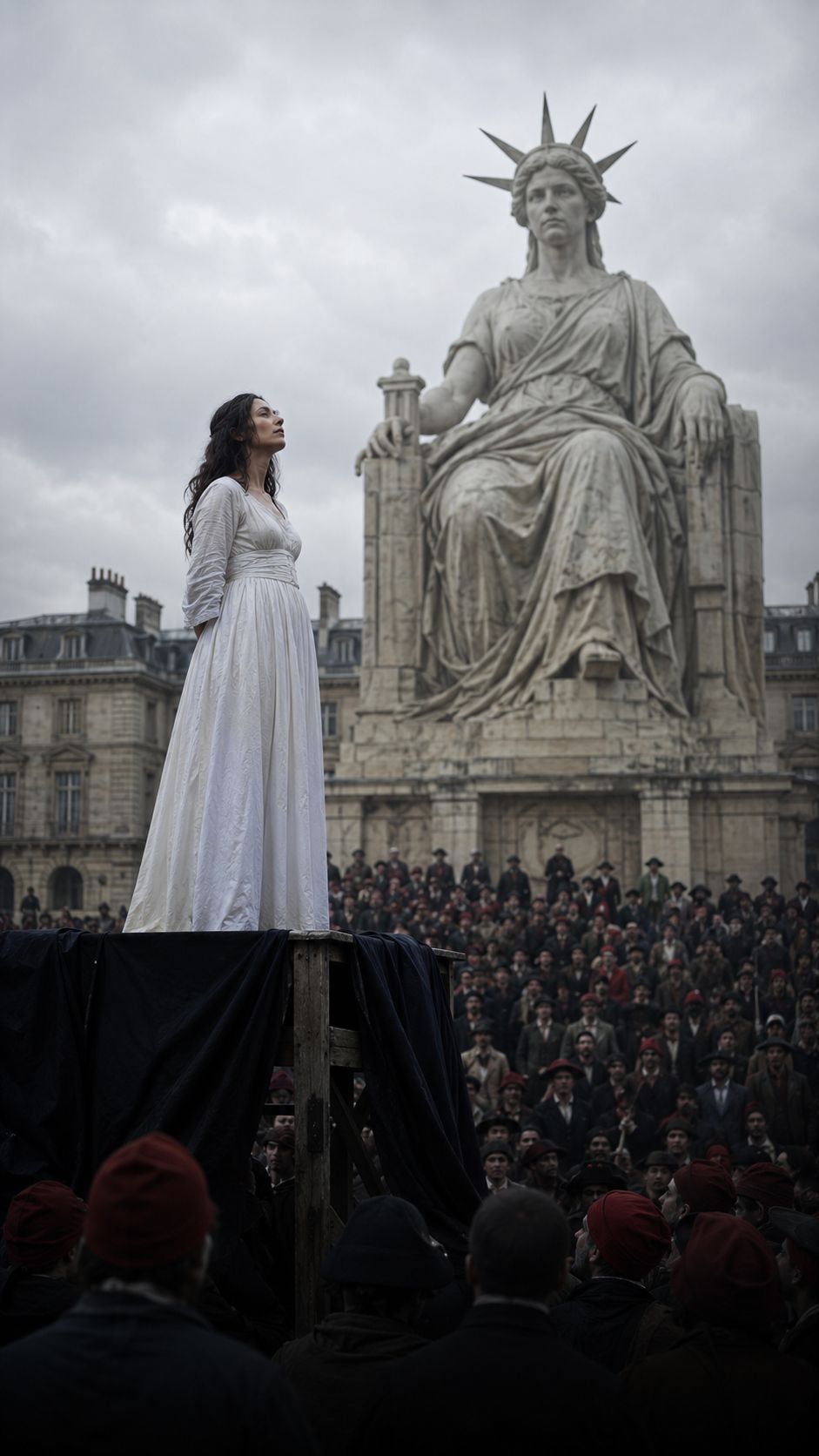 She Faced The Statue Of Liberty Before The Blade Fell
Destroyed by the revolution she helped build, she turned to a statue of Liberty for her final, famous words.
Place de la Révolution, Paris, France · 1793 · same site
 She Wrote Women's Rights Into Existence And Was Guillotined
She demanded the Revolution include women too, and was sent to the same scaffold she had once written about.
Place de la Révolution, Paris, France · 1793 · same site