
On the afternoon of 13th September 1848, near Cavendish, Vermont, a 25‑year‑old railroad foreman named Phineas Gage was doing a job he’d done hundreds of times. He was a master at it — packing explosive powder into holes drilled in rock, then tamping it down with a long iron bar so the blast would break the stone.
His tamping iron was custom‑made to his own design: three feet seven inches long, thirteen and a quarter pounds, an inch and a quarter thick, tapering to a fine point at one end. Someone called out to him. He turned his head. And in that instant, the iron scraped the rock, threw a spark, and ignited the powder beneath it.
THE HORROR The explosion turned the thirteen‑pound bar into a javelin fired from a cannon. It entered point‑first under his left cheekbone, passed behind his left eye, drove straight up through the front of his brain, and burst out through the top of his skull — then flew on for another eighty feet before it hit the ground, smeared with blood and brain.
Phineas Gage should have been killed instantly. He wasn’t. He was thrown onto his back and twitched a few times — and then, impossibly, he spoke. His men, staring in horror, watched him sit up. He was conscious. He was talking. He even walked, with a little help, to the ox‑cart that carried him back to town, and sat upright for the ride.
When the local doctor, John Harlow, arrived, Gage greeted him with a line that has echoed for 175 years. Blood pouring down his face, a hole clean through his head, he looked at the doctor and said: “Here is business enough for you.”
He sat in a chair and calmly watched the doctor work. At one point his brain was visibly pulsing through the wound. He was in his right mind and fully expected to be back at work within days. He had just survived an iron bar passing completely through his brain — while awake.
THE MODERN RELIC He recovered. He lost the sight in his left eye, but he lived. And here is where his case changed human history. The doctor and his acquaintances reported that the Gage who survived was, in some ways, not the same man. The steady, capable, well‑liked foreman had — for a time — become impulsive, foul‑mouthed, and unreliable. His friends said he was “no longer Gage.” For the first time, science had a living human being who showed that damage to a particular part of the brain — the frontal lobes — could alter personality itself. Nearly every psychology textbook on Earth now tells his story.
But here is the part often left out — the part that redeems it. The popular version paints Gage as a ruined shell for the rest of his life. Modern work digging back through the records suggests that’s mostly legend. Gage actually rebuilt himself. He held down a demanding job driving six‑horse stagecoaches on long, difficult routes in Chile — work requiring focus, planning, and social nerve. He may have recovered far more of his character and abilities than the folklore admits. He didn’t just survive the injury; he adapted to it.
He died twelve years later, in 1860, from epileptic seizures linked to the old wound. And this is the relic: years after his burial, his skull was recovered, and today the actual skull of Phineas Gage — with the unmistakable ragged hole blasted through the top — sits alongside the very tamping iron that made it, on public display at the Warren Anatomical Museum at Harvard Medical School.
You can stand in front of it. The skull of the man who took a thirteen‑pound iron bar through his brain, told the doctor to get to work, and lived to drive stagecoaches. The hole is still there. So is the iron. And you can look at both.
Nearby on the Dark Atlas
 The Massacre Behind The Last Of The Mohicans
A famous novel turned it into a simple tale of savagery — the truth is a tangled web of broken promises and desperate people.
Lake George, United States · 1757 · 90 km away
 The First to Hang at Salem
Convicted on nothing but a dream of her spectre, she was the first person executed in the Salem witch trials.
Salem, Massachusetts, United States · 1692 · 169 km away
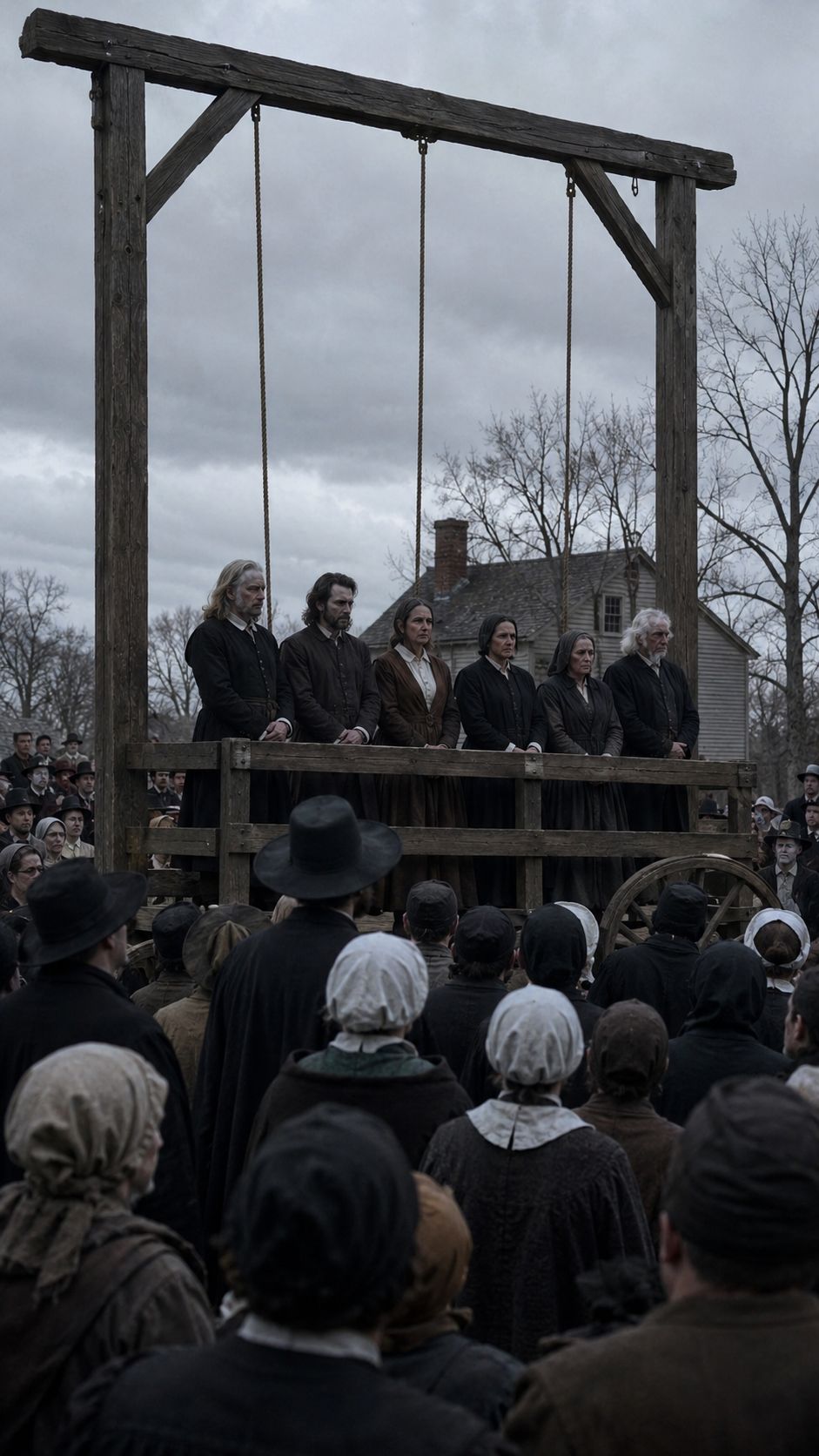 The Killing Ground of Salem
A colonial village turned mass hysteria into mass execution, hanging dozens on a single barren ridge.
Salem, Massachusetts, United States · 1692 · 169 km away
- The Enslaved Woman Who Started the Salem Witch Trials
Her confession to save herself named two other women as witches, setting off accusations that would kill twenty people.
Salem, United States · 1692 · 169 km away
More like this
- The Leper King's Story No Film Would Show
Kingdom of Heaven gave him a dignified death behind a silver mask, the truth was far crueller.
Jerusalem, Israel · 1185
 The Rape Trial That Ended In Trial By Combat
A woman's accusation of rape led to France's last judicial duel, with her own life staked on the outcome.
Paris, France · 1386
- The Parish Registers Of The Beast's Victims
Between 1764 and 1767 something killed roughly a hundred people, recorded in the registers as 'devoured by the beast.'
Saugues, France · 1764
- The Manufacturing Of England's Most Haunted House
For decades it was called the most haunted house in England, until its ghost story revealed how a haunting gets made.
Borley, Essex, United Kingdom · 1929