In 1340, a fifteen‑year‑old Galician noblewoman named Inês de Castro arrived at the Portuguese court as lady‑in‑waiting to Crown Prince Pedro’s new wife, Constanza. Pedro and Inês fell in love. After Constanza died in 1345, Pedro lived with Inês openly. They had several children together. Pedro’s father, King Afonso IV, insisted the relationship end. Pedro refused.
In 1355, while Pedro was away hunting, Afonso sent three men to the Monastery of Santa Clara in Coimbra, where Inês was staying. They found her with her children. They killed her in front of them. Pedro’s grief turned into fury. He rose in revolt against his own father and Portugal slid toward civil war.
The Horror
Afonso died in 1357. Pedro became king. His revenge was brutal and intimate. He hunted down two of the three assassins; the third escaped and was never found. The captured men were put to death in a way that matched his rage: their hearts were torn from their chests while Pedro watched — some chronicles say during a public banquet, one heart ripped from the front, the other from the back.
Then he changed the story forever. Pedro announced, before witnesses, that he had secretly married Inês years before her murder. If true, it meant she had been Queen of Portugal all along, and that their children were legitimate heirs to the throne. Whether the secret marriage actually happened is still debated by historians. What matters for the legend is that Pedro treated it as real.
He ordered Inês’s body exhumed from Santa Clara and taken to the great Cistercian Monastery of Alcobaça, about fifty miles away. A contemporary chronicler wrote that a thousand men carried candles along the route, “in such a way that always the body was enlightened.” Later historians tried to capture the image: “Inês de Castro was led to Alcobaça between two lines of stars.”
Legend adds an even darker flourish: that Pedro had her corpse dressed in royal robes, seated or propped on a throne, crowned as queen, and that he forced the court to kneel and kiss her dead hand in homage. This grisly coronation scene appears in sources written centuries later, so many historians treat it as doubtful or embroidered. But some facts are not disputed: she was formally proclaimed queen after death, she was exhumed, and she was given one of the most magnificent royal funerals Portugal had ever seen.
For their afterlife, Pedro commissioned two great tombs carved in creamy Coimbra limestone — one for Inês, one for himself. They are among the masterpieces of Gothic funerary art in Europe. Each lid bears a life‑sized effigy: six angels support the figure, lifting the royal mantle and raising the head as though to make their sleep more comfortable. Inês holds a glove in one hand and lightly touches a necklace with the other. Her face is calm, almost serene.
Pedro had the tombs placed facing each other across the transept of the abbey church. The symbolism was deliberate: on Judgement Day, when the dead rise, the first thing each will see is the other. He died in 1367 and was laid in his own tomb. For nearly seven centuries, their stone figures have lain there, looking toward each other across the empty space he measured out for eternity.
The Modern Relic
The Monastery of Alcobaça is now a UNESCO World Heritage Site, open to visitors. Step into the cool, pale church and the two tombs still face one another across the transept floor, exactly as Pedro ordered. The angels still lift their heads and hold the heavy cloaks. Inês’s stone hand still rests against her necklace. The candles that once made “two lines of stars” are gone, and the royal procession is long over, but the distance between the two tombs — and the story that put them there — has not moved.
Nearby on the Dark Atlas
 The Queen Locked Away For Forty-Six Years
Branded 'mad' by the men who wanted her throne, she may have been one of history's most cruelly wronged queens.
Tordesillas, Spain · 1509 · 321 km away
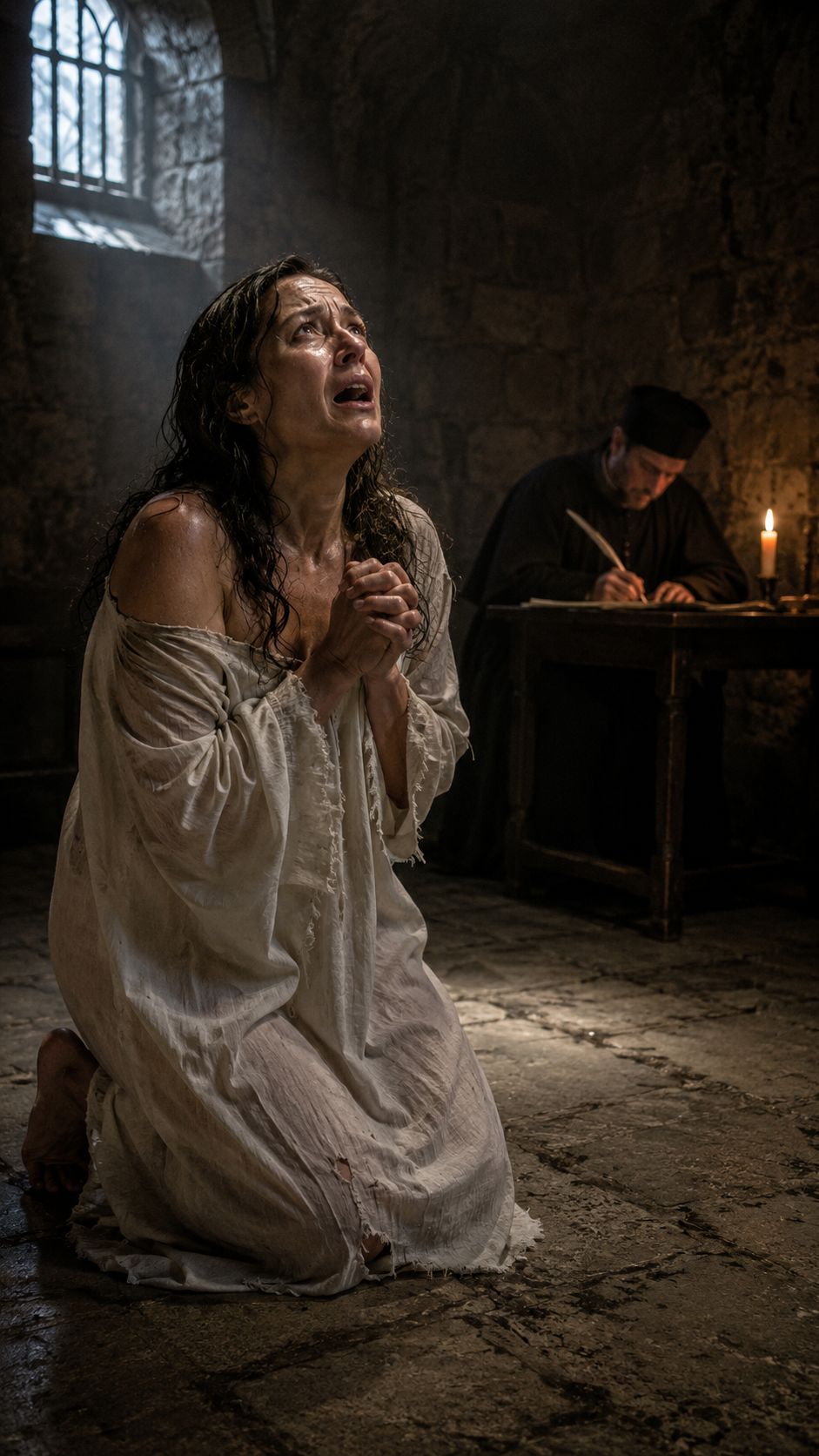 The Woman Condemned For Clean Clothes
Not eating pork and washing on Saturdays was enough for the Spanish Inquisition to put her to the rack.
Toledo, Spain · 1567 · 375 km away
- The Heart Thrown Into Battle Against The Enemy
Surrounded and facing certain death, the knight hurled his dead king's heart into the enemy line and followed it.
Teba, Spain · 1330 · 481 km away
- The Execution Designed To Keep Victims Alive Longer
Hanging a person upside down kept blood in the brain long enough for the saw to finish its work.
Meknes, Morocco · 1705 · 746 km away