
Mary Dyer had already been thrown out of Boston once. In 1638, she’d stood by her friend Anne Hutchinson — a woman convicted of heresy for the crime of holding Bible study groups and suggesting God might speak to ordinary people directly, rather than only through the clergy. When Hutchinson was condemned and banished, Mary Dyer walked out of that church hand in hand with her, in front of everyone. Both women and their families were exiled to Rhode Island.
Then Mary went to England, and there she met the Quakers. Their belief was simple and, to the Puritan rulers of Massachusetts, utterly intolerable: that the light of God is inside every person, and no minister or magistrate stands between you and it. When she came home to New England in 1657 as a Quaker preacher, she was walking into a colony that had decided her faith was a plague.
THE HORROR Massachusetts escalated in stages, and the record of it is genuinely sickening. First imprisonment. Then whipping. Then a law authorising them to cut off one ear for a first offence and the second ear for a second offence — a punishment they actually carried out on three men, who were then beaten twice a week for nine weeks. And finally, in October 1658, by a vote of twelve to eleven — a single vote — the General Court authorised the ultimate penalty: banishment on pain of death. Come back, and we hang you.
Mary Dyer kept coming back. When she heard her friends had been mutilated, she and five other women walked from Providence to Boston to protest. She was arrested in Connecticut. She was banished again. And in 1659 she returned once more to visit two imprisoned Quakers, William Robinson and Marmaduke Stevenson — and was arrested with them and sentenced to death.
Then came the cruellest thing anyone in this story did.
Mary’s son, William Jr., diverted a ship to Boston to beg for his mother’s life. He went to Governor John Endecott’s house and pleaded. Endecott knew that hanging a woman carried political risk — Massachusetts governed under a royal charter, and London might not like it. So he agreed to spare her.
But not simply. He set a condition, and it was pure cruelty dressed as mercy. Mary would not be told. She would be marched the mile to the gallows believing she was about to die. She would be forced to watch Robinson and Stevenson hanged in front of her. Then she would climb the ladder herself, have her face covered with a cloth, and feel the rope put around her neck. And only then, at the very last second, would someone shout that she was reprieved.
The Governor’s own explanation, recorded in the chronology of the case, was that she needed to “experience the chill of death to get some sense in her head.”
They did exactly that. Two hundred armed men, drums beating. Her friends died in front of her. She climbed the ladder. The cloth went over her face. The rope went round her neck. And then the cry came: Stop — she is reprieved.
It did not put sense in her head. Mary Dyer had not asked for the reprieve and did not want it. She was hauled out of Massachusetts against her will, and she was furious — because she understood exactly what had been done. She’d been used as a prop. And worse: the Court then wrote to London bragging about their mercy in sparing her, using her as proof that they were reasonable men.
When Mary heard about that letter, she made her decision. If they wanted to use her survival to justify the law, she would take that away from them. She would force them either to repeal the law — or to kill her in front of everyone and let the world see it.
On 21 May 1660, Mary Dyer walked back into Boston. Deliberately. Knowing.
Ten days later she stood in front of Governor Endecott, who asked her: “Are you the same Mary Dyer that was here before?” She answered: “I am the same Mary Dyer that was here the last General Court.” He asked if she would admit to being a Quaker. She said she owned herself to be so reproachfully called. He passed the sentence — prison that night, the gallows at nine the next morning. Mary’s reply is one of the great lines in American history: “This is no more than what thou saidst before.”
She told the court plainly why she was there: she had come in obedience to God, to ask them to repeal their unrighteous laws of banishment on pain of death — and if they refused, the Lord would send others of His servants to witness against them. Endecott, sneering, asked if she was a prophetess. When she began to answer, he shouted: “Away with her! Away with her!”
Her husband William — who was not a Quaker and never shared her beliefs — wrote a desperate letter begging for her life. It was ignored.
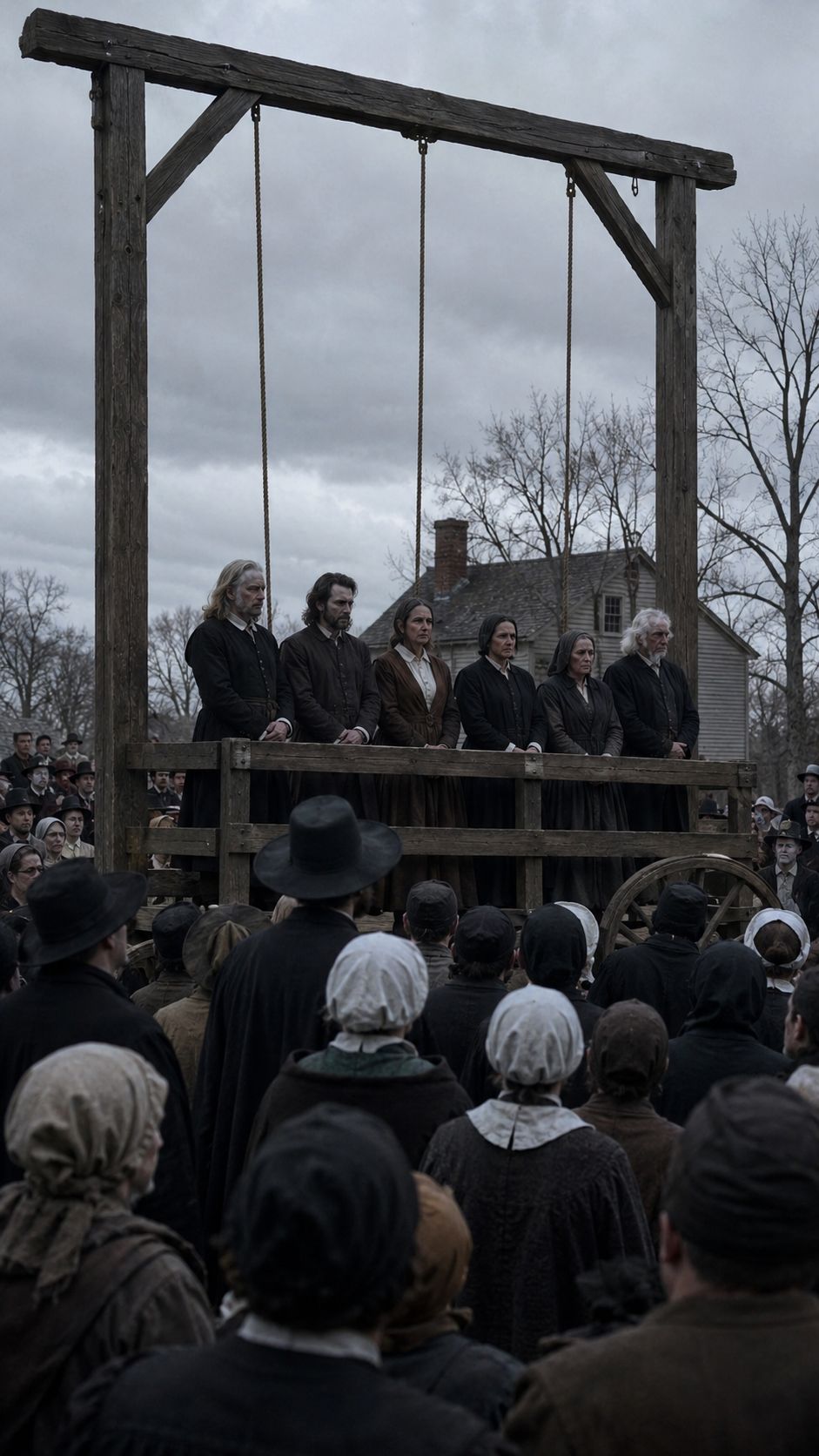
On 1 June 1660, at nine in the morning, they marched her a mile from the jail to a great elm on Boston Common, surrounded by soldiers — and with drummers beating in front of her and behind her the entire way, deliberately, so that nobody in the crowd could hear a single word she said. People shouted at her to just go back to Rhode Island and save herself. Over the drums, she called back that she could not go back, for in the will of the Lord she had come, and in His will she would abide faithful to death.
Her last recorded words were that she had been in paradise for several days, and was now about to enter eternal happiness.
Then they hanged her.
THE MODERN RELIC And her killers handed her immortality by accident. As Mary Dyer hung there, a breeze caught her skirt and billowed it out, and General Humphrey Atherton — one of the officials who had persecuted her — shouted that she hung like a flag. He meant it as a taunt: a warning banner, a body strung up as an example to any other Quaker thinking of testing them. He even said elsewhere that she “did hang as a flag for others to take example by.”
He could not have been more right — or more wrong. The line went around the colonies and across the Atlantic, and it became the most famous thing ever said about her — not a warning, but an epitaph. She hangs like a flag. Quakers claimed it instantly. Atherton was dead within fifteen months, thrown from his horse; a great many Quakers considered that a settled account.
And Mary Dyer won. That was the point: she had gambled her life on the certainty that the world would recoil, and it did. Word of her execution reached England, and in 1661 the Quaker Edward Burrough got an audience with the newly restored King Charles II and told him what Massachusetts was doing — describing, in detail, Mary Dyer’s two walks to the gallows. Charles II explicitly forbade the colony from executing anyone for being a Quaker. The killings stopped. As one summary puts it, the hanging of Mary Dyer marked the beginning of the end of the Puritan theocracy: the charter was revoked in 1684, a royal governor imposed in 1686, and a broad Toleration Act passed in 1689.
The relic is the best kind. Go to Boston today and walk up to the Massachusetts State House — the seat of the government that killed her. Sitting right outside it, in bronze, is Mary Dyer. She’s seated, calm, facing out toward the Common where they hanged her. There’s a statue of Anne Hutchinson there too — the friend she walked out of that church with, hand in hand, three hundred and eighty years ago.
The government that hanged her for her beliefs now has her sitting at its front door, in bronze, forever. And she’s still looking at the spot.
Nearby on the Dark Atlas
 America's First Woman Hanged For Piracy
A farm girl drawn to the docks confessed to almost every crime imaginable the day before she was hanged in Boston.
Boston, Massachusetts, United States · 1789 · same site
 The First to Hang at Salem
Convicted on nothing but a dream of her spectre, she was the first person executed in the Salem witch trials.
Salem, Massachusetts, United States · 1692 · 22 km away
 The Killing Ground of Salem
A colonial village turned mass hysteria into mass execution, hanging dozens on a single barren ridge.
Salem, Massachusetts, United States · 1692 · 22 km away
- The Enslaved Woman Who Started the Salem Witch Trials
Her confession to save herself named two other women as witches, setting off accusations that would kill twenty people.
Salem, United States · 1692 · 22 km away