On 3rd September 1658, Oliver Cromwell — Lord Protector of England, the man who had signed the death warrant of King Charles I — died of natural causes in his bed. He was buried in Westminster Abbey with full state honours.
Two years later, the dead king’s son came home.
The Horror
On 30th January 1661 — the twelfth anniversary of Charles I’s execution, chosen deliberately — Charles II had Cromwell’s body exhumed from Westminster Abbey. The corpses of Cromwell, Henry Ireton and John Bradshaw were taken to Tyburn, hanged from the gallows and left there until later in the day, in a ritual “execution” of already dead traitors.
Afterwards, the executioner removed Cromwell’s head. Some later accounts say it took eight blows of the axe; that detail can’t be verified beyond doubt but is part of the traditional story.
The head was placed on a tall iron spike and mounted on the roof of Westminster Hall — the very building where Cromwell had presided over the High Court that condemned Charles I. The man who had killed a king now “looked down” from the roof of the place where the king’s trial had been held.
The head remained on display there for decades. Contemporary and later sources generally agree that it was still on Westminster Hall into the 1680s, which is where the “24 years” figure comes from.
According to the later narrative, around the mid‑1680s a storm broke the spike and sent the head crashing to the ground. A sentry on duty picked it up and took it home rather than handing it in; when he heard there might be questions or a reward, he allegedly hid it and kept it until his death, after which it passed to his family.
By the early 18th century the head surfaces in a small private museum in London run by Claudius (or Claudius) Du Puy, a Swiss‑French collector. After Du Puy’s death it passed through several hands. It eventually ended up with Samuel Russell, a showman and sometime actor, who displayed it for paying visitors — the “failed comic actor” of later retellings.
Russell sold it on to a jeweller; the jeweller then sold it in 1815 to Josiah Henry Wilkinson, a surgeon. The Wilkinson family kept the head in an oak box for roughly a century and a half. Visitors to the Wilkinsons left descriptions of a small mummified head with parchment‑like skin and a beard still visible.
In 1934, two researchers (one of them the medical historian Karl Pearson) examined the head in detail. They concluded that it almost certainly was Cromwell’s, based on several factors: traces of careful embalming consistent with a state funeral, evidence of a later impalement through the skull consistent with a spike, and a striking resemblance to known portraits. They remarked on the unique combination of “honour and disgrace” — state burial followed by posthumous execution.
On 25th March 1960 — about 299 years after the head was removed from Cromwell’s body — it was finally buried at Sidney Sussex College, Cambridge, where Cromwell had studied as a young man. It was interred still inside the Wilkinsons’ oak box.
The exact burial spot was kept secret. The college agreed to mark only the general area, not the precise location, to discourage attempts to dig it up. A small plaque in the antechapel reads: “Near to this place was buried on 25 March 1960 the head of OLIVER CROMWELL, Lord Protector of the Commonwealth of England, Scotland & Ireland.”
The Modern Relic
Sidney Sussex College is open to visitors, and the plaque can be seen in the antechapel. That word “near” does all the work: the head is somewhere close to where you stand, but not directly under your feet, and only a small circle of people ever knew exactly where the box was placed.
The college’s own register once carried a scathing marginal note next to Cromwell’s name — “that great impostor, that most accursed butcher” — reflecting the fierce hostility many Anglicans felt toward him in the decades after his death. The same institution eventually agreed to give his head a quiet burial and to protect it from further display, theft, or curiosity.
By the time it went into the ground, the head had spent almost three centuries above it: first as a warning on Westminster Hall, then as a hidden keepsake, then as a curiosity in private museums and drawing rooms, and finally as a scientific specimen in a surgeon’s box. Cromwell ruled England for less than a decade; his head spent far longer as an object passed from hand to hand.
Nearby on the Dark Atlas
- The Pretender Who Confessed on a Platform
A man who claimed to be a lost prince was forced to publicly unravel his own legend before the gallows.
Tyburn, London, United Kingdom · 1499 · same site
 The Man Who Died Worse Than A Queen
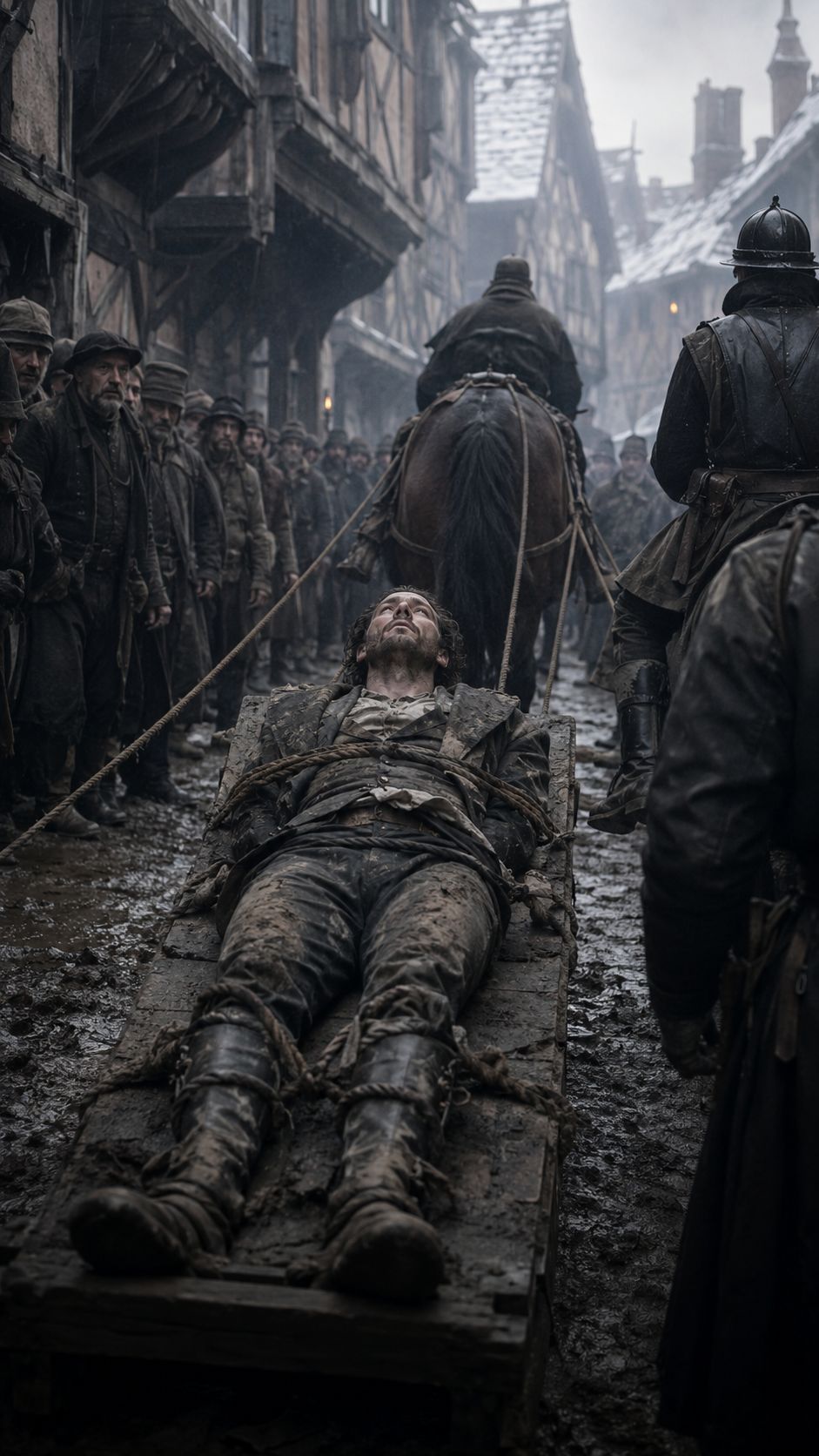
Before Henry VIII ever met Catherine Howard, a secret in her past would drag her lover to a death crueler than her own.
Tyburn, London, United Kingdom · 1541 · same site
 The Silent Monks Who Died First
Before Thomas More, before anyone famous, silent Carthusian monks were the first men Henry VIII executed for defying him.
Tyburn, London, United Kingdom · 1535 · same site
- The Boy Who Woke Up on the Dissection Table
Hanged and pronounced dead at 17, he opened his eyes as surgeons prepared to cut him open.
Tyburn, London, United Kingdom · 1740 · same site