On 4th May 1535, three men in white robes were dragged on hurdles through the streets of London to Tyburn. They were Carthusian monks — the most austere, most silent, most devoted monks in England. They lived in cells. They spoke only during prayer. They spent their lives in solitude with God.
At Tyburn, they were hanged until half dead, cut down, castrated, disembowelled, and quartered — the full sentence for high treason. Their crime: they had refused to acknowledge Henry VIII as head of the Church. They were the first to die. Before Thomas More. Before John Fisher. Before anyone famous. The monks went first.
Thomas More watched from the Tower. He could see Tyburn from his cell. He turned to his daughter Margaret and said: “Lo, dost thou not see, Meg, that these blessed fathers be now as cheerfully going to their deaths as bridegrooms to their marriage?” He would follow them to the scaffold two months later.
After the execution, Henry sent a message to the remaining monks of the London Charterhouse. He had the prior’s severed arm nailed to the arch above the entrance to their own monastery — so they would see it every time they walked through the gate. Their prior’s arm. Their own door. The message was not subtle.
THE HORROR Some monks broke. They signed the oath. They survived. Ten did not.
On 29th May 1537, the ten who refused were taken to Newgate Prison. They were not tried. They were not sentenced. They were not formally condemned. There was no pretence of law. Henry had moved past law.
They were chained standing upright to wooden posts in a dungeon. Their hands were tied behind their backs. They could not sit. They could not lie down. They could not feed themselves. They were left.
No food. No water. No trial date. No charge. The instruction was silence — the absence of an order, which was itself the order. They were to remain chained until they were no longer alive.
Then Margaret Clement came.
She had been born Margaret Giggs — raised in the household of Thomas More as his ward and adopted daughter. She had grown up in the same house as Margaret Roper, who would later retrieve More’s head from London Bridge. She had been educated alongside More’s own children — taught Latin, taught Greek, taught to think.
Now she was standing outside Newgate Prison with a milk pail on her head.
She bribed the gaoler. She told him she was a milkmaid delivering supplies. He let her in. She walked through the prison — past criminals, past debtors, past the dying — to the dungeon where ten monks stood chained to posts in their own filth.
She fed them. She carried meat hidden inside the milk pail. She spooned it into their mouths — because their hands were tied behind their backs and they could not feed themselves. She cleaned them. She wiped the filth from their habits. She did what she could with what she had — a pail, a lie, and the hands of a woman whose father had already been killed by the same king who was starving these monks.
She came back. Day after day. She kept them alive.
Henry noticed. He asked why the monks hadn’t died yet. The gaoler was questioned. Margaret was discovered. She was banned from the prison.
The monks starved. Over the summer of 1537, they died — one by one, chained to their posts, standing in a dungeon in Newgate. The first died on 6th June. The last — Thomas Johnson — held on until 20th September. Four months. Chained upright, without food, in the dark.
THE MODERN RELIC The London Charterhouse still stands — in Smithfield, near Barbican, in the centre of London. After the dissolution, it became a Tudor mansion, then a school, then an almshouse. It is now partly occupied by the Charterhouse Museum and partly by a community of elderly pensioners — a residential home for men who have served the military or the public.
The gate where the prior’s arm was nailed is part of the complex. The spot where ten monks stood chained in a dungeon is somewhere beneath the streets of Smithfield. The city built itself on top of the place where men died standing.
Margaret Clement fled England under Elizabeth I — she went into exile in Mechelen, in the Spanish Netherlands, rather than conform to the Protestant settlement. She died there on 6th July 1570 — the anniversary of Thomas More’s execution. On her deathbed, her daughter reported that Margaret could see figures standing around her bed — white-robed monks, the same monks she had fed in Newgate thirty-three years earlier.
She said they were calling her to come with them.
Nearby on the Dark Atlas
 The Man Who Died Worse Than A Queen
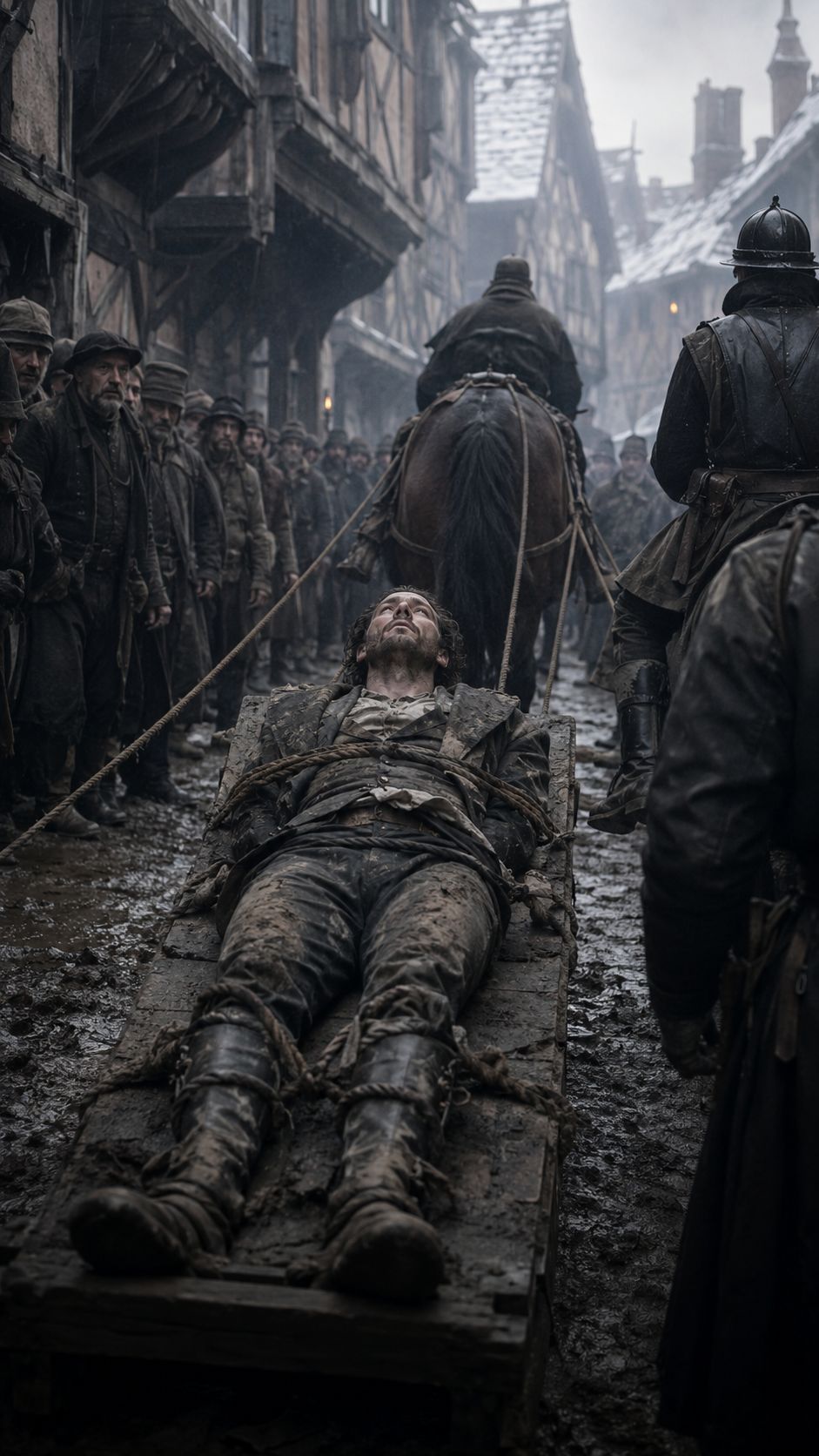
Before Henry VIII ever met Catherine Howard, a secret in her past would drag her lover to a death crueler than her own.
Tyburn, London, United Kingdom · 1541 · same site
- The Boy Who Woke Up on the Dissection Table
Hanged and pronounced dead at 17, he opened his eyes as surgeons prepared to cut him open.
Tyburn, London, United Kingdom · 1740 · same site
- The Last Woman Burned Alive for Politics in England
Betrayed by the man she sheltered, she arranged her own straw to make the fire catch faster and end it quickly.
Tyburn, London, United Kingdom · 1685 · same site
- The Man Who Survived His Own Hanging
He hung strangling at Tyburn for fifteen minutes before a reprieve arrived, and he lived for decades afterward.
Tyburn, London, United Kingdom · 1705 · same site