
Marie-Thérèse-Louise of Savoy, the Princesse de Lamballe, had every chance to live. She chose loyalty instead, and it destroyed her in one of the most horrifying deaths of the French Revolution.
Born in Turin in 1749, she married into the French royal family as a teenager and was widowed almost immediately, at just eighteen. At the court of Versailles she became the dearest and most trusted friend of the young queen, Marie Antoinette — a genuine, deep friendship in a place where real affection was rare. The queen loved her, confided in her, and kept her close for years.
The Horror
When the Revolution erupted in 1789 and turned dangerous, Lamballe did the sensible thing: she left France and reached the safety of England. She was out. She was alive. She could have stayed there and grown old in peace.
She went back.
Unable to abandon her friend to face the darkness alone, the Princesse de Lamballe voluntarily returned to France and to Marie Antoinette’s side, knowing exactly how dangerous it was. She had been the target of vicious revolutionary propaganda — filthy pamphlets that painted her as the queen’s lover — and she knew she was hated. She came anyway.
When the royal family was imprisoned in August 1792, Lamballe was arrested with them and then separated, thrown into the grim La Force prison. And a few days later, Paris exploded into the September Massacres — days of frenzied mob slaughter in which crowds broke into the prisons and butchered more than a thousand people in makeshift “trials.”
On the 3rd of September, they dragged the Princesse de Lamballe before one of these mob tribunals. They gave her a way out. All she had to do was swear an oath of hatred against the King and Queen, and denounce them, and she would be freed.
She would not. She said she would swear loyalty to liberty, but she would never denounce the King and Queen. It was her death sentence, and she knew it.
She was handed to the waiting mob and killed. She was decapitated, and — in the horror that defined that week — her head was fixed on the point of a pike.
The Modern Relic
Then the crowd had an idea. They carried her severed head through the streets to the Temple, the tower where the royal family was held, so that they could show it to Marie Antoinette. The King’s valet, Cléry, was there and left an eyewitness account. A head on a pike was raised to the window. A woman screamed. The murderers outside, thinking the scream came from the queen herself, roared with laughter. Marie Antoinette was mercifully kept from seeing it — some say she fainted when told what was outside — but she understood exactly what had happened to the friend who had come back for her.
Lamballe’s body was never recovered. There is no grave.
Her loyalty became her monument. In an age when many of the queen’s friends fled and saved themselves, the Princesse de Lamballe became the symbol of the one who stayed — who traded the safety of England for a pike outside a prison window, because she would not let her friend face the end alone. In Paris today, a plaque marks the site of the old La Force prison where she was held and died. And her name endures as one of the great acts of doomed loyalty in history: a woman who was free, and safe, and chose to come back and die rather than betray the person she loved.
Nearby on the Dark Atlas
- The Assassin Torn Apart With Molten Lead
A student's failed attempt on the King's life ended with red-hot pincers and molten lead poured into his open wounds.
Paris, France · 1594 · same site
 The Assassin Whose Severed Head Blushed
She murdered a revolutionary leader in his bath to save France, and witnesses swore her severed head reddened afterward.
Paris, France · 1793 · same site
 The Book That Outlived Its Author's Pyre
A woman was burned for writing that the soul could reach God without the Church, but her banned book kept circulating in secret for centuries.
Paris, France · 1310 · same site
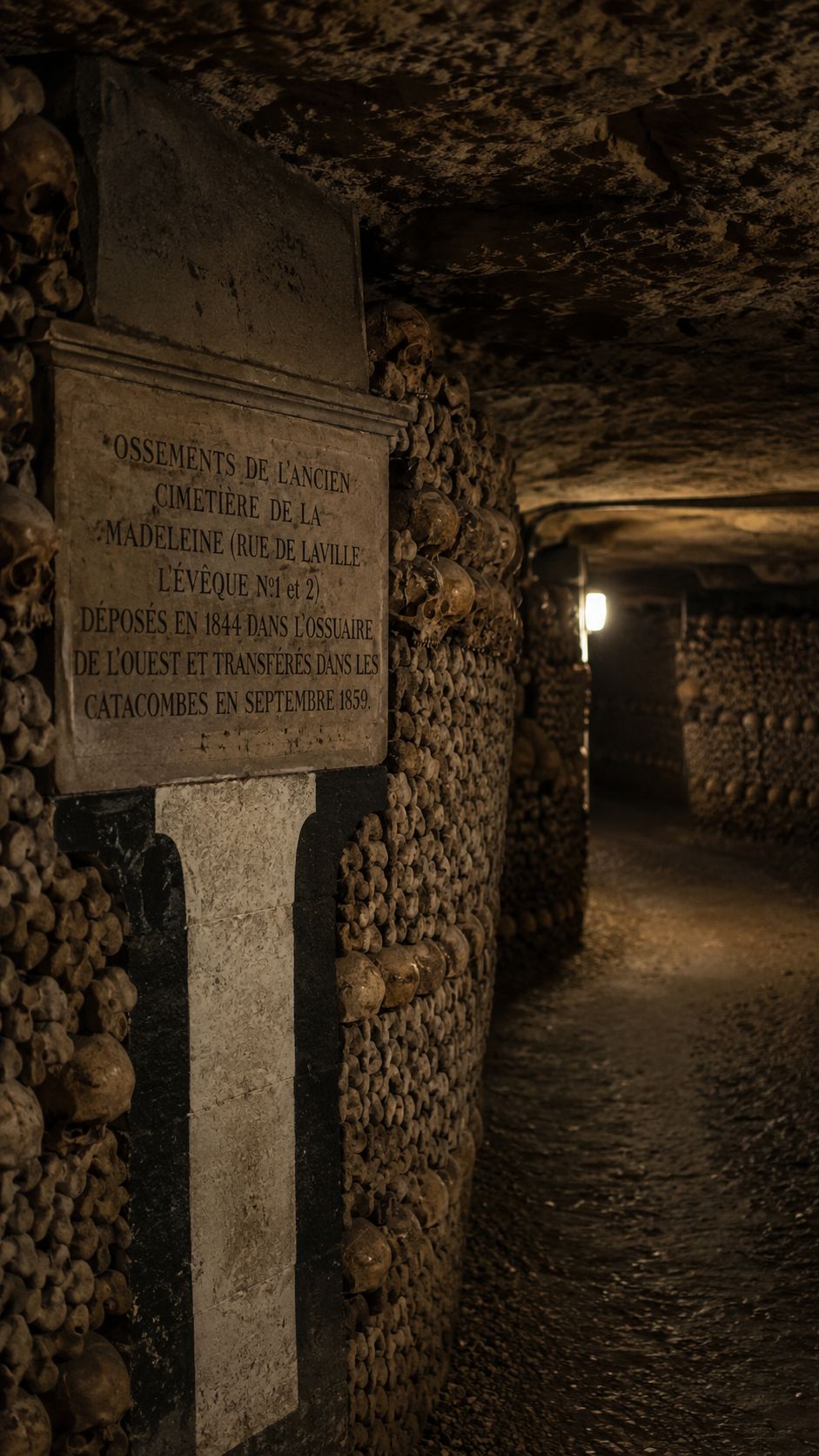 The Cemetery That Rose Above The Streets
Centuries of bodies raised a Paris graveyard eight feet above the surrounding streets before it finally gave way.
Paris, France · 1780 · same site