
The most successful pirate who ever lived never wanted to be one.
John Roberts was born in a Welsh village in 1682, went to sea at thirteen, and by 1719 was a respectable, experienced ship’s officer — third mate on a London slave ship called the Princess, off the coast of Ghana. He was thirty‑seven years old, and his life was ordinary.
Then pirates took his ship. Their captain, Howell Davis, was also Welsh, and he needed skilled navigators — so Roberts was pressed into the crew by force. He didn’t want it. By every account he was a reluctant, resentful prisoner among men he considered criminals.
Six weeks later, Howell Davis was killed in an ambush. And the crew, in the way of pirates, held a vote for a new captain. They chose the newcomer — the forced man who could navigate. Roberts took it, reportedly reasoning that if he was going to be in this life anyway, it was better to be a commander than a common man.
He had been a pirate for about a month and a half. He would be dead in three years. And in between, he became the most successful pirate in the history of the world.
THE HORROR The numbers are almost impossible. In three years, Bartholomew Roberts captured over 400 ships. Some estimates run to 470. That is more than Blackbeard, Captain Kidd, Calico Jack and Stede Bonnet took combined, several times over. He raided from Newfoundland to Brazil to the coast of West Africa, crossing the Atlantic to strike wherever nobody expected him. He once sailed into a Newfoundland harbour and captured twenty‑two ships in a single go. He took an entire eleven‑ship fleet off Africa in one operation.
And he did it by being the exact opposite of what you picture. Roberts was a disciplinarian who despised drunkenness and chaos. He drank tea. He wrote a pirate code — lights out at eight, no gambling, no fighting aboard ship, compensation for the wounded, a fair vote on every prize. He was a manager who happened to be a criminal.
He also dressed like a man who knew he was the most wanted person on the ocean and simply did not care. The contemporary account of his last battle describes him: a rich crimson damask waistcoat and breeches, a red feather in his hat, a gold chain around his neck with a diamond cross hanging from it, a sword in his hand, and two pairs of pistols slung across his shoulders on a silk sling. He went into a gunfight with the Royal Navy dressed like that.
But this is not a swashbuckling story, and it shouldn’t be told as one. In January 1722 Roberts captured eleven ships at Whydah and demanded a ransom of eight pounds of gold dust per ship. One master refused to pay. So Roberts had his men set that ship on fire — and there were around eighty enslaved Africans chained in its hold. They burned, or drowned, or were taken by sharks when they jumped. The reason he gave was that unshackling them would have wasted his time. Black Bart was not a folk hero. He was a mass murderer in a red silk coat.
THE MODERN RELIC The Royal Navy sent a man to end him: Captain Chaloner Ogle of HMS Swallow, a fifty‑gun warship. Ogle hunted him for months across the Atlantic.
On 10 February 1722, off Cape Lopez in what is now Gabon, Ogle found him. Roberts’s crew had spent the previous night celebrating a capture and most were badly hungover; Roberts himself, the story goes, was eating breakfast. Seeing a sail approaching, he assumed it was one of his own ships returning — by the time he realised it was a warship, it was too late.
Roberts rallied his drunk crew and made a bold call: sail straight past the Swallow, take one broadside on the chin, and run for open water. It was the right decision. But as they made the pass, his helmsman lost the course — and the Swallow swung round and delivered a second broadside.
Grapeshot is dozens of lead balls fired from a cannon like a giant shotgun, designed to shred men rather than ships. As Roberts stood on his own deck in his crimson silk, the grapeshot found him and tore his throat out. He died instantly, still dressed for the occasion.
And here is the last thing about him. Roberts had told his crew, over and over, what to do if he fell: do not let them have my body. He knew exactly what the Navy did with dead pirates — Blackbeard’s head had been hung from a bowsprit four years earlier, and the bodies of hanged men were sealed in iron cages and left to rot in harbours as warnings. Roberts had decided he would not become a scarecrow.
So while the battle still raged around them, his crew wrapped the captain in his own ship’s sail, weighted him down with his sword, his chain, his diamond cross and every ornament still on him, and slid him over the side into the Atlantic. Minutes later, leaderless, they surrendered.
The body of Bartholomew Roberts has never been found. He is still down there, somewhere off the coast of Gabon, in his crimson silk.
The aftermath was savage. His surviving crew were taken to Cape Coast Castle in modern Ghana and tried in the largest pirate trial in history: fifty‑two men were hanged — the largest mass execution of pirates ever carried out. And seventy‑seven African crewmen who had sailed with Roberts were not tried at all. They were simply put back in chains and sold back into slavery.
Roberts’s death is widely taken as the end of the Golden Age of Piracy. It never recovered.
And the relic is one of the strangest objects in any museum. Captain Chaloner Ogle — knighted for the kill, the only Royal Navy officer ever knighted specifically for defeating a pirate — had a cup carved from a coconut shell made to commemorate his victory. That cup survives, and it’s held by the National Maritime Museum in Greenwich, London. The most successful pirate in history has no grave, no monument, and no body. What he has instead is a coconut, on a shelf in a museum, made by the man who killed him.
Nearby on the Dark Atlas
- The Poison In Napoleon's Wallpaper
A dying emperor believed he was being murdered, and centuries later his own wallpaper became a suspect.
Longwood House, Saint Helena, Saint Helena · 1821 · 2324 km away
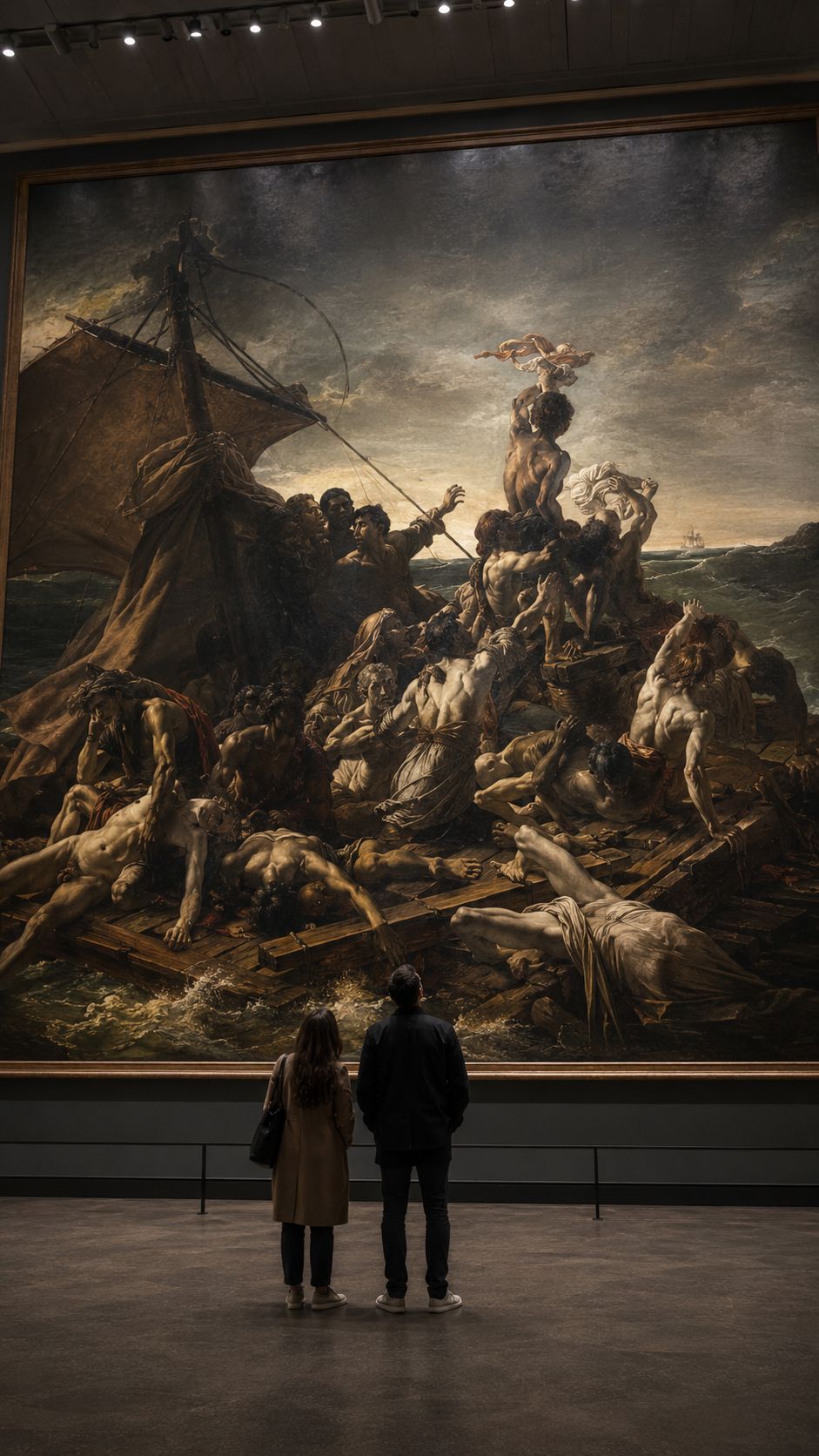 The Raft That Inspired A Masterpiece
147 people were abandoned on a raft in the Atlantic — starvation, madness and cannibalism followed before rescue.
Arguin Bank, off Mauritania, Mauritania · 1816 · 3660 km away
- The Defence That Held At Rorke's Drift
A hundred and fifty men, many pulled from hospital beds, barricaded a mission station against four thousand Zulu warriors.
Rorke's Drift, South Africa · 1879 · 3861 km away
 The Tomb Robber's Charge Sheet
A 3,200-year-old papyrus names the women a powerful Egyptian craftsman was accused of assaulting, and his own tomb still stands as evidence.
Deir el-Medina, Egypt · 1150 BC · 3892 km away
More like this
 The Pirate Hanged Twice In One Morning
A respected captain became a public scapegoat for piracy, and even his execution refused to go as planned.
London, United Kingdom · 1701
 The Pirate Whose Skull Was Stolen Twice
Legend says his headless body kept walking past his own men after execution, and his skull was later stolen from a museum.
Hamburg, Germany · 1401
- The Wreck That Inspired Moby Dick
A real sperm whale rammed and sank a Nantucket ship, leaving its crew to face the unthinkable to survive.
Nantucket, Massachusetts, United States · 1820
 The Doomed Voyage To The Northwest Passage
129 men and the most advanced polar ships on earth vanished into the Arctic ice without a trace.
King William Island, Canada · 1845