
On 30th May 1431, a nineteen‑year‑old French peasant girl named Jeanne d’Arc was led to the Old Market Square in Rouen and burned at the stake. She had been tried by an ecclesiastical court, convicted of heresy, and condemned to die.
In barely eighteen months, she had helped reverse the course of the Hundred Years’ War, lifted the siege of Orléans, pushed the English back, and escorted Charles VII to his coronation at Reims. She was nineteen.
The charge that killed her was not military. It was not political. It was about clothes.
The Horror
Joan had worn male clothing throughout her campaign — armour, hose, a tunic laced together as one piece. She said the voices of saints instructed her to dress this way. Practically, it also mattered: a laced tunic attached to hose was far harder to strip off than a woman’s dress. In an army camp and later in captivity, that mattered.
After her capture by Burgundian forces, she was sold to the English and brought to Rouen. There, under the control of Bishop Pierre Cauchon, she was interrogated for weeks. The list of accusations was long — heresy, sorcery, false visions, immodesty — but the specific, technical offence the court could pin down was her clothing.
Joan was held in a secular, military prison, not a Church prison with female warders. Her guards were English soldiers. She later testified that they had tried repeatedly to assault her. She wore the laced male outfit as her only protection.
During the trial, she was offered a way out: abjure, sign a recantation, put on women’s dress, and her sentence would be reduced. Under immense pressure and fear of immediate burning, she signed a document she likely did not fully understand and agreed to wear a dress.
Within days, her women’s clothing disappeared from her cell. Only male garments remained. Accounts differ on exactly how and why. Some sources say the guards took away the dress to force her back into men’s clothes and secure a “relapse” conviction. Others say she chose to put her old clothes back on after a new assault attempt.
What is certain: when the judges returned, she was wearing men’s clothing again. That was enough. Under canon law, returning to “heresy” after abjuration — even on this technical point — made her a relapsed heretic.
She was condemned for wearing the only clothes she had.
On the morning of 30th May, she was brought to the marketplace. A high wooden scaffold with a stake had been built; the height made it difficult for the executioner to shorten her suffering. She asked for a cross. An English soldier fashioned one out of two bits of wood and handed it to her. Another cleric held a crucifix aloft so she could see it.
The fire was lit. Witnesses said she cried “Jesus!” several times before she died. She was nineteen.
After she was dead, the executioner was ordered to rake back the fire and expose the body to the crowd — to prove that Joan of Arc was female and truly dead, leaving no room for rumours of escape or substitution. Then the fire was built up again and her body burned a second time. Then a third. Finally, what remained was gathered and dumped into the Seine.
They wanted nothing left — no bones that could become relics, no ashes that could anchor a shrine, no physical focus for a cult of “Saint Joan.”
The Modern Relic
In 1456, twenty‑five years after her death, a papally authorised retrial examined the original proceedings. Witnesses from Orléans and Rouen testified; the earlier verdict was annulled. Joan was declared innocent; the 1431 trial was branded corrupt.
Nearly five centuries later, in 1920, the Catholic Church canonised her as Saint Joan of Arc. The institution that had once burned her as a heretic now honoured her as a national patron and saint.
Today, the Église Sainte‑Jeanne‑d’Arc stands in Rouen’s Old Market Square, on the approximate site of the execution. Built in 1979, the church’s sweeping roof evokes tongues of flame. A simple cross set into the pavement marks the spot where the stake stood.
Market stalls selling fruit and flowers ring the square. Tourists photograph the church, step over the cross without noticing, and buy produce where a nineteen‑year‑old girl was burned three times for wearing clothes her jailers had forced upon her.
The crime on paper was fabric. The real crime was that the fabric was the only protection she had.
Nearby on the Dark Atlas
 Was Van Gogh's Death Not A Suicide
A dying artist may have covered for the boys who accidentally shot him rather than name them.
Auvers-sur-Oise, France · 1890 · 88 km away
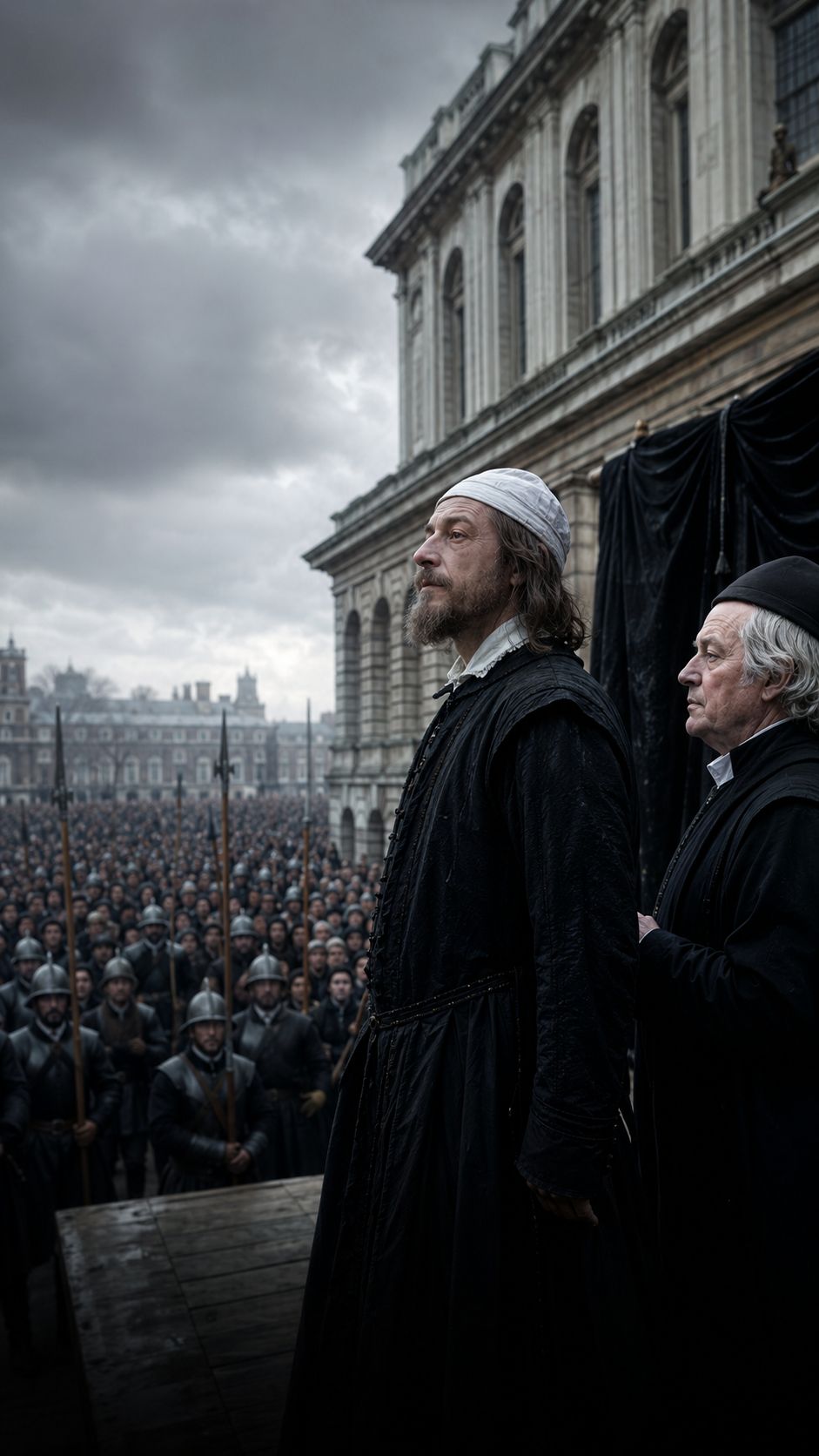 Tortured To Death Over A Hat
A nineteen-year-old nobleman was tortured and executed for blasphemy in a case that scandalised all of Enlightenment Europe.
Abbeville, France · 1766 · 91 km away
 Betrayed By The Friend Who Stood At Their Wedding
The revolutionary firebrand and his devoted wife were destroyed by the very friend who once witnessed their marriage.
Place de la Révolution, Paris, France · 1794 · 110 km away
 Devoured By The Revolutionary Machine He Built
He helped build the tribunal that sent thousands to the guillotine, and then it turned on him too.
Place de la Révolution, Paris, France · 1794 · 110 km away