In the autumn of 1698, Peter the Great returned to Moscow from his Grand Embassy across Europe. He had been studying shipbuilding in Holland and England. He had been imagining a modern Russia. He came home to a rebellion. The Streltsy — an elite military guard, the Kremlin’s own praetorians — had revolted in his absence, attempting to install his half-sister Sophia on the throne. The rebellion had already been crushed by Peter’s generals. Two thousand prisoners were waiting. Peter did not delegate.
The Horror
The executions began in October 1698 and continued in waves — each day a new method, a new location, a new lesson. The Austrian diplomat Johann Georg Korb was present. He recorded everything. On the first day, 144 men were beheaded in Red Square. Peter ordered his nobles — boyars, princes, men who had never held a weapon in anger — to serve as executioners. Those who hesitated were humiliated. Peter told them: “No victim is more acceptable to God than a wicked man.” Then Peter picked up an axe and beheaded five men himself. The Tsar of all the Russias — the most powerful man between Poland and the Pacific — stood in Red Square with blood on his hands and an axe in his grip. He was not ordering death. He was performing it. He swung the blade and watched the heads roll because he wanted his court to understand that this was not politics. This was personal. His favourite, Alexander Menshikov, did not share the nobles’ squeamishness. He drove through Moscow in a sledge, brandishing a sword, and boasted of personally beheading twenty men in a single session — taking a drink of brandy between each swing. On another night, Peter turned execution into a drinking game. He ordered twenty prisoners brought into a banquet hall while he and his companions were dining. One by one, he beheaded them at the table — a swig of brandy between each blow — while his guests watched. In total, 1,182 Streltsy were executed between September 1698 and February 1699. Others were broken on the wheel. Others had their flanks torn with hot pincers. Others were whipped to death with the knout. The corpses were not removed. Peter forbade it. The bodies hung from the battlements of the Kremlin and from gallows across Moscow for five months — through the autumn, through the Russian winter, into the spring. Moscow woke up and went to sleep looking at the dead. And Peter reserved a special display for his sister. Sophia was imprisoned at the Novodevichy Convent. Peter ordered the bodies of executed Streltsy hung directly outside her cell windows — each corpse holding in its stiffened hand the written petition the dead man had carried, asking Sophia to take the throne. For five months, every time Sophia looked out of her window, she saw the men who had died for her, holding the letters they had written to her, rotting in the snow.
The Modern Relic
Vasily Surikov’s painting The Morning of the Streltsy Execution — completed in 1881, nearly two centuries after the event — hangs in the State Tretyakov Gallery in Moscow. It is one of the most famous paintings in Russian art. It shows Red Square at dawn, the condemned men in white shirts, their families weeping, Peter on horseback in the background — small, distant, watching. The Novodevichy Convent is a UNESCO World Heritage Site. Tourists visit the white walls, the golden domes, the cemetery where Chekhov and Gogol are buried. The window of Sophia’s cell is part of the complex. The gallows that hung outside it are gone. The petitions the dead men held are gone. The bodies are gone. What remains is a window, and the knowledge of what was once outside it.
Nearby on the Dark Atlas
- The Cossack Rebel Torn Apart In Red Square
He led the greatest rebellion the Tsars ever faced, and was taken apart alive before a silent crowd.
Red Square, Moscow, Russia · 1671 · same site
- The Night Stalin Silenced His Own Poets
Thirteen of the Soviet Union's greatest Jewish writers were led into a basement and shot in a single night.
Lubyanka Prison, Moscow, Russia · 1952 · same site
- The Father Who Killed His Own Heir
A single blow in a fit of rage killed his son and heir, and the moment was later painted so disturbing a man attacked it with a knife.
Alexandrov, Russia · 1581 · 99 km away
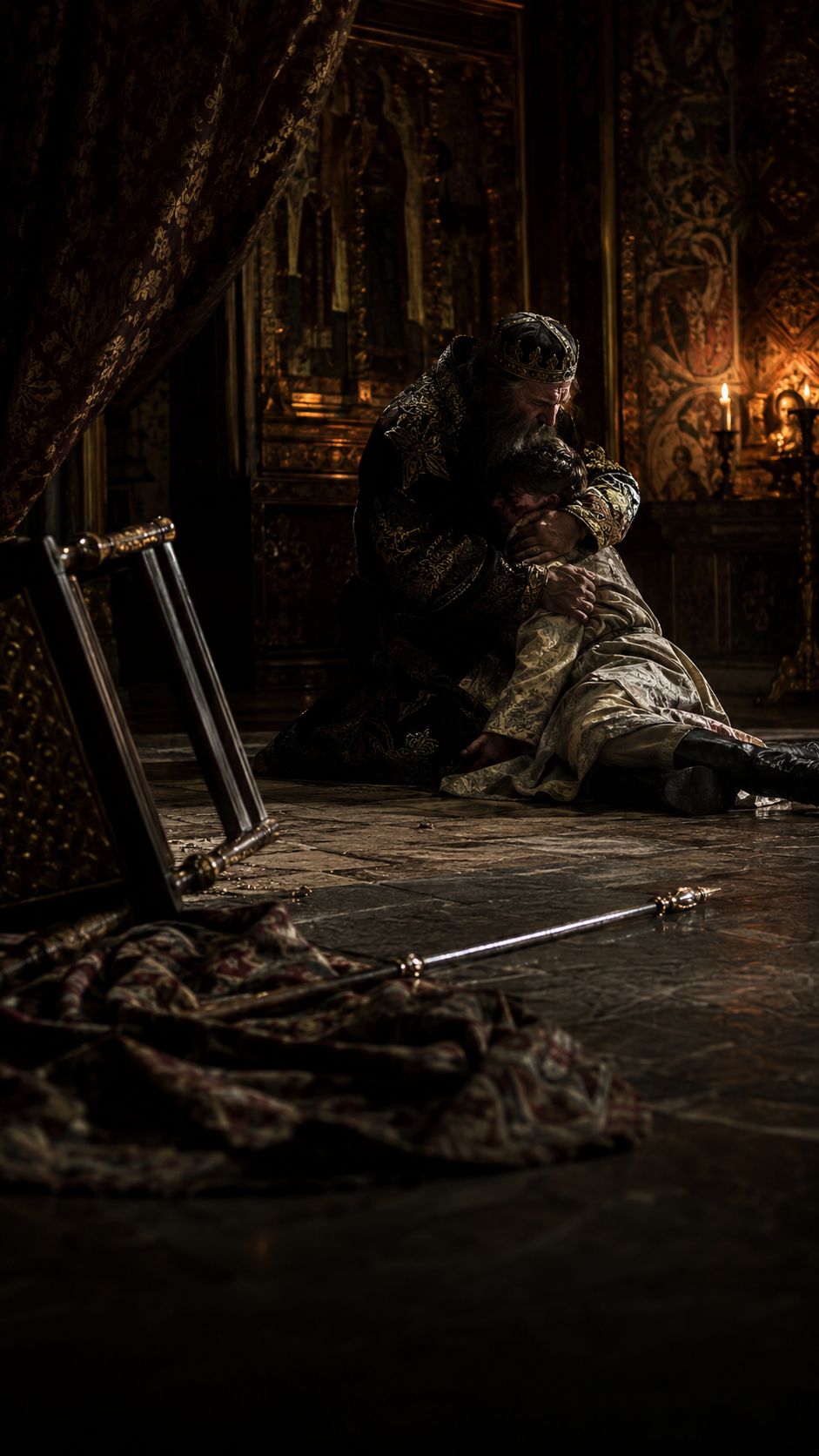 The Staff That Killed A Tsar's Own Heir
A row over his pregnant daughter-in-law's clothing ended with Ivan striking his own son with an iron-tipped staff.
Alexandrov, Russia · 1581 · 100 km away