
Every night, Marie Curie and her husband Pierre would walk into their laboratory in the dark. They would close the door. They would let their eyes adjust. And then they would watch.
Everywhere — on the shelves, in the drawers, on the benchtops — small glass tubes and capsules glowed. A soft blue‑green light filled the darkness, pulsing faintly, as though the room itself was breathing. Radium. Polonium. Substances that nobody had known existed until Marie found them.
She wrote in her autobiography: “One of our joys was to go into our workroom at night; we then perceived on all sides the feebly luminous silhouettes of the bottles and capsules containing our products. It was really a lovely sight and one always new to us. The glowing tubes looked like faint, fairy lights.”
She found them beautiful. She carried them in her pockets. She kept them in her desk drawer. She walked through Paris with the thing that was killing her pressed against her body, glowing through the fabric of her coat.
She did not know. Nobody knew. Not yet.
THE HORROR Marie Curie did not discover radiation. She discovered something worse: that certain elements are spontaneously, ceaselessly, permanently radioactive — that they emit energy without stopping, without fading, without ever being asked. She and Pierre coined the word “radioactivity.” They gave the phenomenon its name. They gave the world a word for the thing that would kill her.
She processed around eight tonnes of pitchblende ore — by hand, in a leaking shed, stirring vats with an iron rod — to extract about one‑tenth of a gram of radium. She did this without gloves. Without a mask. Without any protection. The shed had no proper floor. The windows did not close. When it rained, the roof leaked onto the experiments.
The radium glowed. She loved the glow.
She won the Nobel Prize in Physics in 1903 — shared with Pierre and Henri Becquerel. She was the first woman to win a Nobel Prize. In 1911, she won a second — in Chemistry, alone. She remains the only person in history to win Nobel Prizes in two different sciences.
Pierre was killed in 1906 — his skull crushed by a horse‑drawn cart on a rain‑slicked Paris street. Marie continued alone. She carried his research forward. She carried radium in her pockets. She carried both.
By the 1920s, her health was failing. Her fingers were burned and scarred from handling radioactive materials. Her eyesight was deteriorating. Her bone marrow was being destroyed — cell by cell, year by year — by the radiation she had spent her life studying.
She died on 4th July 1934, at the age of sixty‑six. The cause was aplastic anemia — her bone marrow had been destroyed by decades of radiation exposure. The fairy lights had eaten her from the inside.
THE MODERN RELIC Marie Curie’s personal belongings — her notebooks, her laboratory equipment, her furniture, her clothing, and her cookbooks — are still radioactive. They will remain hazardous for roughly 1,500 more years. Radium‑226 has a half‑life of about 1,600 years. The contamination she carried home on her hands every evening — into her kitchen, onto her recipe books, into the fabric of her chairs — will outlast almost every building currently standing in Paris.
Her notebooks are stored in lead‑lined boxes in Paris. Anyone wishing to read them must sign a liability waiver and wear protective clothing. The handwriting inside — precise, methodical, the record of one of the greatest scientific minds in history — is dangerous to handle.
Her former lab spaces and associated buildings had to be surveyed and decontaminated long after her death; investigations at the end of the 20th century found significant residual radiation in some sites, requiring expensive cleanup. The work she did in improvised sheds and early labs left a physical trace that is still being erased.
Her body is interred in the Panthéon in Paris — she was the first woman to be placed there on her own merit. Her coffin is lined with lead. The woman who found the fairy lights beautiful is sealed inside metal so that the beauty cannot escape.
Nearby on the Dark Atlas
- The Assassin Torn Apart With Molten Lead
A student's failed attempt on the King's life ended with red-hot pincers and molten lead poured into his open wounds.
Paris, France · 1594 · same site
 The Assassin Whose Severed Head Blushed
She murdered a revolutionary leader in his bath to save France, and witnesses swore her severed head reddened afterward.
Paris, France · 1793 · same site
 The Book That Outlived Its Author's Pyre
A woman was burned for writing that the soul could reach God without the Church, but her banned book kept circulating in secret for centuries.
Paris, France · 1310 · same site
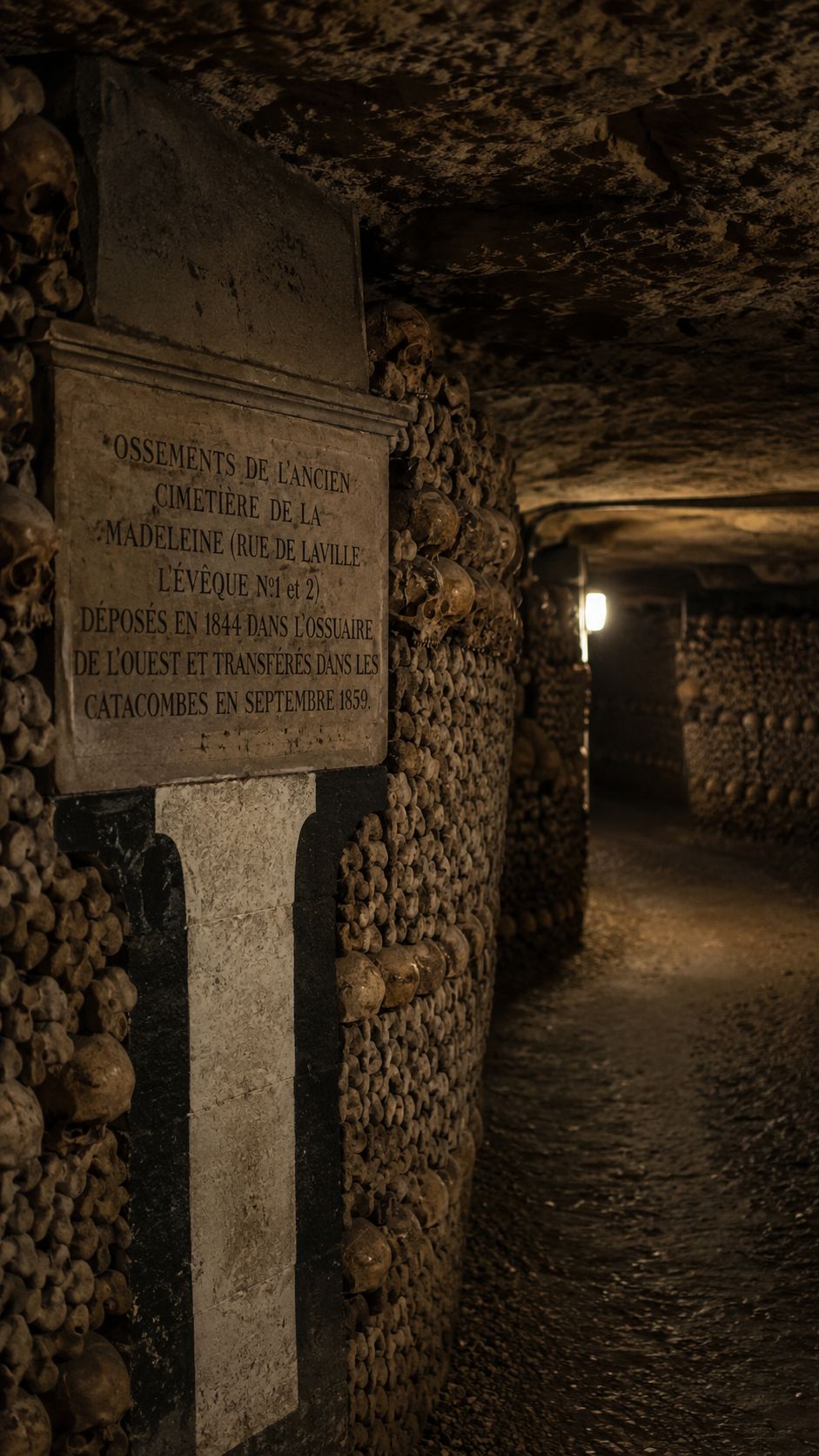 The Cemetery That Rose Above The Streets
Centuries of bodies raised a Paris graveyard eight feet above the surrounding streets before it finally gave way.
Paris, France · 1780 · same site
More like this
- The Leper King's Story No Film Would Show
Kingdom of Heaven gave him a dignified death behind a silver mask, the truth was far crueller.
Jerusalem, Israel · 1185
- The Truth Behind The Elephant Man
The real man behind the famous film was quieter, stranger and far more heartbreaking than any screenplay.
Whitechapel, London, United Kingdom · 1890
 The Soap-Maker Who Murdered For Love
An Italian woman murdered three neighbours and turned their bodies into soap and teacakes, believing she was saving her son.
Correggio, Italy · 1940
 Voltaire's Final Battle With The Church
The Church tried to deny him a grave, but revolutionaries would carry his body to a hero's tomb thirteen years later.
Paris, France · 1778