
In the early 5th century AD, the most respected intellectual in Alexandria — one of the greatest cities in the ancient world — was a woman. Her name was Hypatia. She was a mathematician, astronomer, and philosopher. Her father, Theon of Alexandria, was the last scholar we know for certain worked at the Great Library of Alexandria.
She taught both pagans and Christians. Her lecture hall drew students from across the Mediterranean. The Roman prefect Orestes consulted her on political and civic questions. In a city tearing itself apart along religious lines, she was one of the few figures whom both civic and church authorities listened to. That made her a symbol — and therefore dangerous.
The Horror
In March 415 AD, during the Christian season of Lent, a group of Christian enforcers known as parabalani, led by a church reader named Peter, ambushed Hypatia’s chariot in the streets of Alexandria. They dragged her from it and hauled her into the Caesarion — a former temple to Caesar and the Roman emperors that had been converted into a church.
Inside the church, they stripped her naked. Ancient sources say they then killed her with ostraka — a Greek word that can mean roof tiles, pottery shards, or shells. Whatever the precise material, they were sharp‑edged fragments. One account, from the philosopher Damascius a century later, describes the mob scraping and cutting her flesh from her bones while she was still alive and gouging out her eyes.
When she was dead, they dismembered the body. The pieces were dragged through the streets and taken to a place called Cinaron, where they were burned.
Hypatia had held no official political post. Her “crime” was influence: many Alexandrians believed — or were encouraged to believe — that she was advising the prefect Orestes not to reconcile with the powerful bishop Cyril of Alexandria. In an atmosphere of factional violence between Cyril’s followers and Orestes’ supporters, she became a convenient target. Remove the woman, remove the obstacle.
Her students scattered, many leaving for Athens. With her death, Alexandria’s role as the great centre of learning on the Mediterranean — already weakened by centuries of turmoil — effectively ended. A line of scholarship that ran from the early Ptolemies through the library’s heyday to Theon and Hypatia broke, violently, inside a church.
Cyril, the bishop whose faction carried out the murder, was never formally punished for it. Later church historians tried to distance him from the mob, but no real inquiry touched his position. In 1882, more than 1,400 years later, Pope Leo XIII declared Cyril a Doctor of the Church — an official saint and theological authority. The man whose followers dragged Hypatia into a sanctuary and tore her apart with broken tiles is venerated; she is not.
None of Hypatia’s own writings survive. We know she wrote commentaries on Diophantus’s Arithmetica and Apollonius’s Conics. We know she helped edit and refine her father’s work on Ptolemy’s Almagest. We know she designed or improved instruments such as the astrolabe and hydrometer. We know she was brilliant because other people said so. Her own words have vanished.
The Modern Relic
There is no known grave for Hypatia, no marked tomb, no surviving relic. The Caesarion where she was murdered disappeared centuries ago. The Great Library in which her father worked is long gone.
On Alexandria’s modern seafront, a new Bibliotheca Alexandrina opened in 2002 as a symbolic rebirth of the ancient library: a vast, sloping disc of stone and glass, flooded with light, holding millions of books. It stands not far from where the Ptolemaic library complex once stood. It contains nothing Hypatia wrote.
Around the world, she has become a symbol of learning destroyed by fanaticism, of a woman thinker erased by a mob. In Alexandria itself, there is still no major monument marking the spot where she died. The only things that truly endure are the accounts of her killing — written by Christian and pagan authors alike, by admirers and critics, all agreeing on the essentials:
They killed the smartest person in the city inside a church, during Lent, with broken tiles. The bishop became a saint. The mathematician became ash.
Nearby on the Dark Atlas
 Cleopatra's Children, Rome's Prize
Within weeks of Cleopatra's death, Rome hunted down all four of her children, starting with the teenage son of Julius Caesar.
Alexandria, Egypt · 30 BC · same site
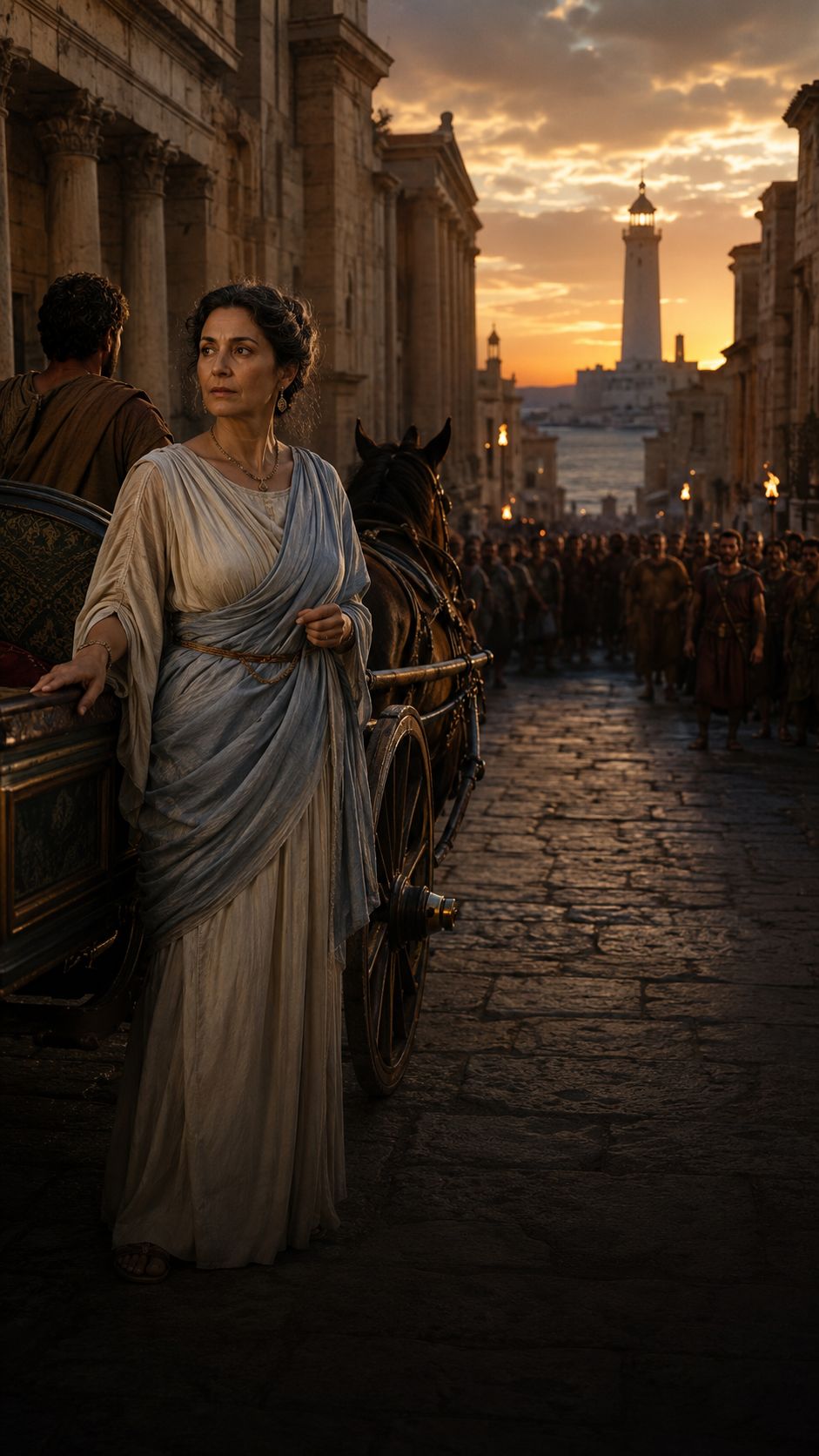 The Philosopher Torn Apart By A Mob
One of antiquity's greatest mathematicians was dragged from her chariot and killed by a mob whose bishop was never punished.
Alexandria, Egypt · 415 · same site
 The Queen Rome Rewrote Into A Villain
The seductress of legend was largely built by the propaganda of the man who defeated her.
Alexandria, Egypt · 30 BC · same site
 The Tax Document That Unlocked Egypt
The most visited object in the British Museum turns out to be a routine bureaucratic decree that happened to unlock a lost language.
Rashid (Rosetta), Egypt · 196 BC · 52 km away
More like this
- The Murder Dickens Turned Into Fiction
A cold, calculated murder buried a body in a Bermondsey kitchen, and became fodder for the country's most famous novelist.
Bermondsey, London, United Kingdom · 1849
- The Chair No One Is Allowed To Sit In
A murderer's cursed armchair now hangs on a museum wall, five feet off the ground, so no one can sit in it again.
Thirsk, United Kingdom · 1702
- The Poisoner Who Weaponised A Town's Sweet Shops
She poisoned an entire town's confectionery to disguise the murder of a woman she hated, killing a child she never met.
Brighton, United Kingdom · 1871
 The Rape Trial That Ended In Trial By Combat
A woman's accusation of rape led to France's last judicial duel, with her own life staked on the outcome.
Paris, France · 1386