
In the early 400s AD, one of the greatest mathematicians and philosophers in the Roman world was a woman — Hypatia of Alexandria. In a society that gave women almost no public role, she did something extraordinary: she became the head of the Neoplatonist school in Alexandria, the intellectual capital of the Mediterranean, teaching mathematics, astronomy, and philosophy to the sons of the empire’s elite. She wrote commentaries on some of the hardest mathematical texts of antiquity. She helped build and use instruments like astrolabes to chart the heavens. Pagans and Christians alike packed her lectures, and the most powerful men in the city sought her counsel. She was, in her time, one of the finest minds alive — and admired for it.
And that is exactly what got her killed.
THE HORROR Alexandria in 415 AD was a powder keg. The city was being torn apart by a savage power struggle between two men: Orestes, the Roman prefect who governed the city, and Cyril, its ambitious and ruthless bishop. Each wanted control, and the streets ran with the violence of rival gangs and religious factions. Hypatia was a close friend and advisor to Orestes. She was also a pagan philosopher — a symbol of the old world of learning — and a woman with more influence than the bishop’s circle could tolerate.
So a rumour was deliberately spread through the Christian population: that this pagan woman, this supposed sorceress, was the only thing standing between the bishop and the governor making peace. That she was bewitching Orestes and poisoning the city. It was a lie — but it was a spark thrown into dry tinder.
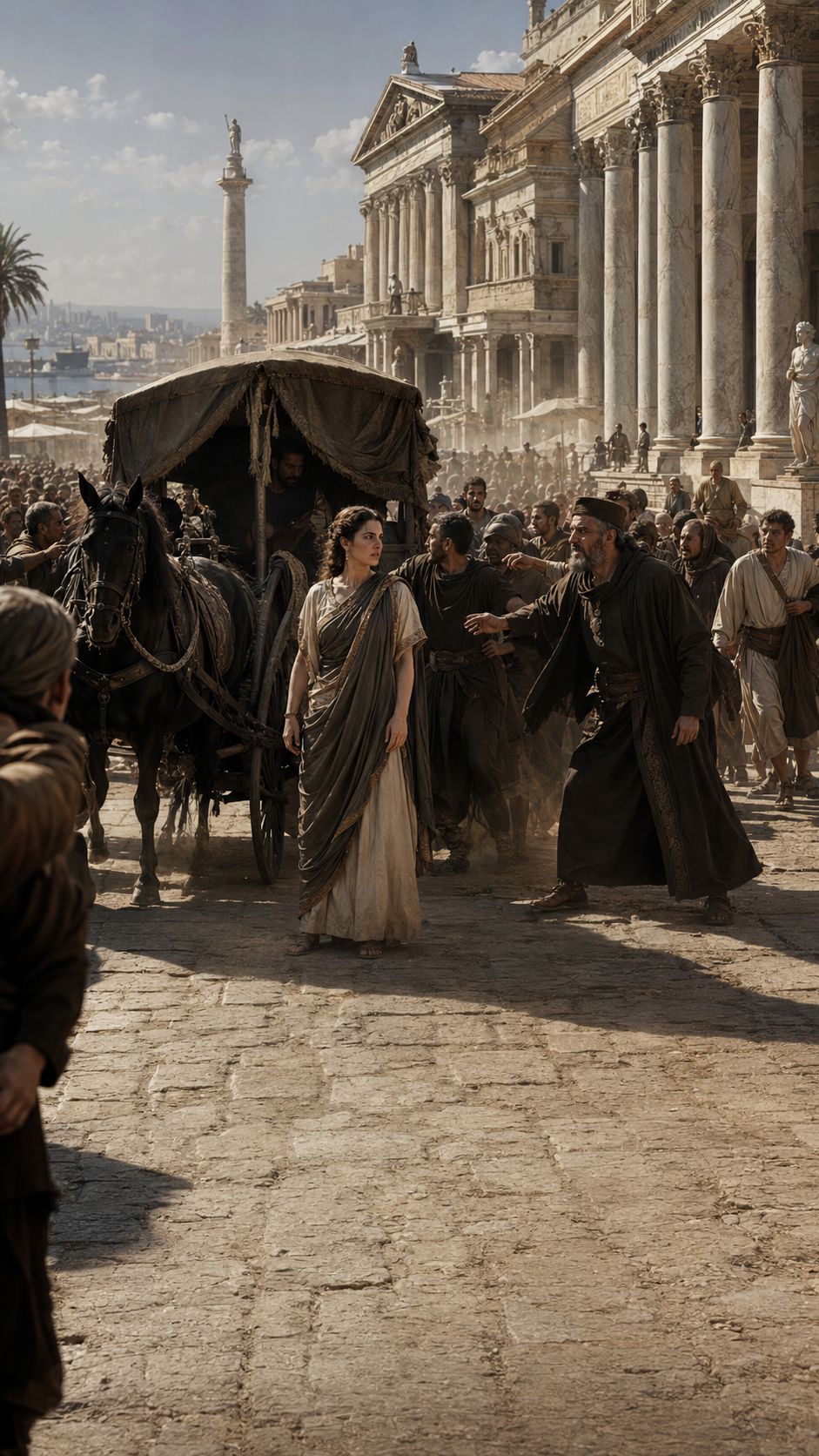
One day during Lent, in March of 415, Hypatia was riding home through the city in her carriage. A mob, led by a church official named Peter, surrounded her. They dragged the philosopher down from her chariot and hauled her through the streets into the Caesareum, a former temple converted into a church. There they stripped her and killed her using sharp fragments — broken pottery or tiles, possibly shells. They dismembered her body, carried the pieces out, and burned them.
It was one of the most shocking murders of the ancient world — not a criminal, not a soldier, but the most respected teacher in Alexandria, torn apart by a mob for the crime of being a powerful, learned pagan woman caught between two men fighting over a city.
THE MODERN RELIC The killing horrified many observers. Even in a brutal age, the public butchery of a revered woman scholar was a step too far, and it left a permanent stain on Alexandria’s church. But the machinery of power protected the powerful. An imperial investigation was opened, then quietly smothered; no one of consequence was truly punished. The bishop widely blamed for inflaming the climate that led to the mob, Cyril of Alexandria, went on to a triumphant career — and centuries later was declared a saint of the Church.
Hypatia’s own writings were lost. Her school faded. For a long time, her enemies nearly succeeded in erasing her — the woman who had been the brightest star of Alexandria reduced to a handful of mentions in ancient texts.
But they failed. The sheer horror of her death made her impossible to forget. Over the centuries Hypatia became a legend — a martyr for reason, learning, and the freedom to think, invoked by philosophers, writers and scientists ever since, and brought to millions in modern retellings of her story. The very act meant to silence her made her immortal.
And the relic is the place itself. You can still walk the ancient stones of Alexandria, and at the site of Kom el‑Dikka archaeologists have uncovered a complex of late‑Roman lecture halls — rows of stone benches in small auditoriums, actual classrooms of late‑antique Alexandria. These are very likely the kind of rooms where Hypatia herself once taught geometry and the movements of the stars to young men of the empire, sixteen centuries ago. You can sit where the students sat, in the ruins of one of the last great schools of the ancient world, and remember the woman they murdered for being too brilliant, too free, and too powerful to leave alone.
Nearby on the Dark Atlas
 Cleopatra's Children, Rome's Prize
Within weeks of Cleopatra's death, Rome hunted down all four of her children, starting with the teenage son of Julius Caesar.
Alexandria, Egypt · 30 BC · same site
 The Philosopher Torn Apart By A Mob
Alexandria's most respected scholar becomes too dangerous a symbol to survive a city tearing itself apart over religion.
Alexandria, Egypt · 415 · same site
 The Queen Rome Rewrote Into A Villain
The seductress of legend was largely built by the propaganda of the man who defeated her.
Alexandria, Egypt · 30 BC · same site
 The Tax Document That Unlocked Egypt
The most visited object in the British Museum turns out to be a routine bureaucratic decree that happened to unlock a lost language.
Rashid (Rosetta), Egypt · 196 BC · 52 km away
More like this
- The Murder Dickens Turned Into Fiction
A cold, calculated murder buried a body in a Bermondsey kitchen, and became fodder for the country's most famous novelist.
Bermondsey, London, United Kingdom · 1849
- The Chair No One Is Allowed To Sit In
A murderer's cursed armchair now hangs on a museum wall, five feet off the ground, so no one can sit in it again.
Thirsk, United Kingdom · 1702
- The Poisoner Who Weaponised A Town's Sweet Shops
She poisoned an entire town's confectionery to disguise the murder of a woman she hated, killing a child she never met.
Brighton, United Kingdom · 1871
 The Rape Trial That Ended In Trial By Combat
A woman's accusation of rape led to France's last judicial duel, with her own life staked on the outcome.
Paris, France · 1386