
In the autumn of 1685, an elderly woman in her late sixties was led out into the marketplace at Winchester to be executed. Her name was Lady Alice Lisle, and her crime was not rebellion, not treason in the ordinary sense, not violence. Her crime was giving fugitives food and shelter for a single night. For that act, she was first sentenced to be burned alive at the stake, and then, as a mercy, beheaded. Her death became one of the most infamous alleged judicial murders in English history.
To understand how an elderly gentlewoman ended up on the executioner’s block for sheltering fugitives, you have to understand the terror that gripped England in the summer of 1685. The Duke of Monmouth had risen in rebellion against King James II, and his rebellion had been crushed at the Battle of Sedgemoor. And then came the vengeance. King James unleashed his Lord Chief Justice, George Jeffreys, a man history remembers as “the Hanging Judge,” to punish the rebels and those accused of aiding them. The campaign of retribution became known as the Bloody Assizes. Around three hundred people were executed, and hundreds more were transported to the colonies, many into harsh terms of indentured servitude. And one of the first and most notorious cases of that bloody circuit was Lady Alice Lisle.
The Horror
Her story is heartbreakingly simple. In July 1685, a Nonconformist minister named John Hickes, a fugitive after the failed rebellion, came to her home at Moyles Court in Hampshire and begged for shelter. Lady Lisle, an aged widow with sympathies for religious dissenters, took him in. Hickes arrived with a second man, Richard Nelthorpe, a lawyer and fugitive who had also been linked to earlier anti-government plotting. The two men spent one single night under her roof. The next morning, soldiers arrived and arrested them. And they arrested Lady Lisle too, charging her with the crime of harbouring traitors.
Her defence was honest and reasonable. She insisted that she had no idea Hickes had been part of the armed rebellion, believing him merely to be wanted for the far lesser offence of illegal preaching. She swore she had never even heard of the second man, Nelthorpe, whose name had not been included in the official charge against her but was dragged into the proceedings anyway, helping the Crown make her look worse. And she declared that she had no sympathy whatsoever with Monmouth’s rebellion. She was, in short, an old woman who had given fugitives a bed for the night and insisted that she had no idea she was committing treason.
But she had the terrible misfortune to be tried at the opening of the Bloody Assizes, before Judge Jeffreys himself, at Winchester in August 1685. And her trial became the kind of proceeding that helped define Jeffreys’ monstrous reputation for all time. He made little pretence of being a fair judge. He behaved, as one historian put it, less like an impartial arbiter and more like an extra prosecutor, browbeating witnesses and turning the proceedings against the frightened old woman in the dock.
And here is the detail that reveals the horror of what was done to her. The jury hesitated over the evidence. Accounts differ over the exact sequence and wording, but later historians and commentators recorded that the jurors had doubts about whether the charge had truly been proven. They struggled with the idea that an elderly woman could be executed for giving shelter to a man who had not even been convicted of treason when she took him in.
And so Judge Jeffreys pressured them. He raged at the jury, expressing furious disbelief that they could possibly hesitate in what he called so plain a case. Contemporary and later accounts describe him browbeating the jurors and making it clear that he expected conviction. Some later narratives say that he threatened to keep them without food, fire, or light until they agreed, although the exact wording and sequence are disputed. What is beyond doubt is that the jury, after showing reluctance, returned with the verdict Jeffreys wanted: guilty.
The Modern Relic
The sentence that followed was savage beyond belief. Because the law of the time made no distinction between a principal and an accessory in a case of treason, Lady Alice Lisle, a woman in her late sixties who had done nothing violent, was sentenced to suffer the traitor’s death prescribed for women: to be burned alive at the stake. And Jeffreys ordered that this elderly woman be burned that very same afternoon. A brief respite was granted after desperate appeals, and the matter went to the King. But James II refused to pardon her. His only concession, granted in supposed respect for her rank, was to allow her to be beheaded rather than burned alive.
On the 2nd of September 1685, Lady Alice Lisle spent her final hours at the Eclipse Inn in Winchester. Then she walked out into the marketplace, before the assembled crowd, to die. And by every account, she met her terrible end with extraordinary dignity, calm, and courage. An elderly woman condemned to death for sheltering fugitives faced the executioner’s axe composed to the very last. She was buried at the church at Ellingham.
But history did not let the injustice stand. Lady Lisle’s death caused outrage and became a notorious symbol of the Bloody Assizes. Her case set the sickening tone for the trials that followed. And when King James II was himself overthrown just a few years later in the Glorious Revolution, Parliament under William and Mary reversed her attainder, officially overturning the legal consequences of her conviction. The contemporary historian and bishop Gilbert Burnet called her a martyr. And ever since, her death has often been remembered by that damning phrase: judicial murder.
The story of Lady Alice Lisle endures because it strips a great historical terror down to its simplest and most human form. She was not a soldier, not a conspirator, not a rebel. She was an elderly woman who opened her door to fugitives, claiming that she did not know the full seriousness of the danger they were in. And for that, a vengeful king and a bullying judge decided she must die, so determined to secure conviction that they placed immense pressure on the jury to agree. She gave shelter to fugitives for one night, and it cost her her head. Her only real crime, in the end, may have been mercy in a time and place that had decided mercy itself could be treated as treason.
Nearby on the Dark Atlas
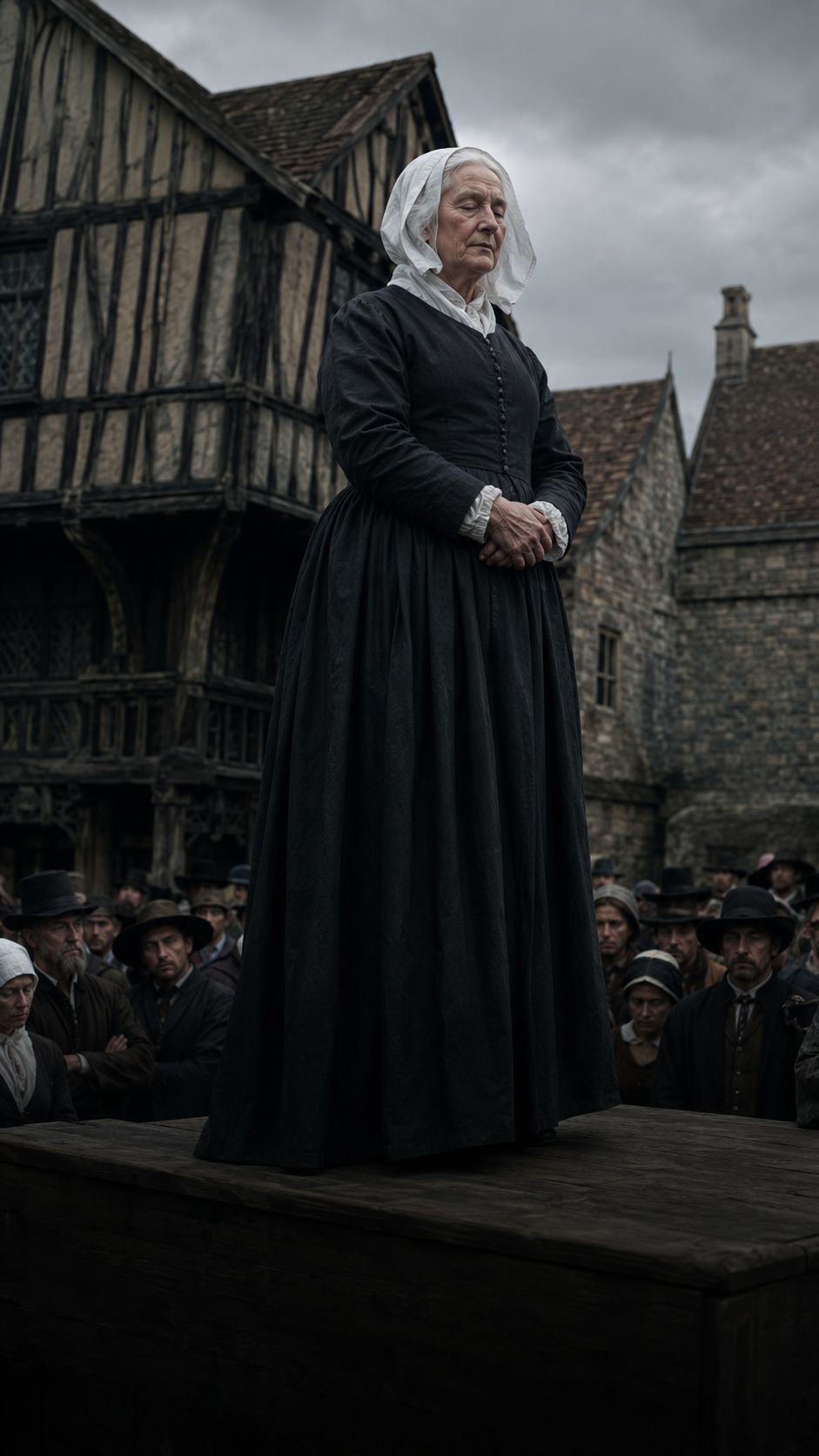 The Hanging Judge's First Victim
An elderly woman sheltered fugitives after Monmouth's failed rebellion, and the Hanging Judge made her his first target.
Winchester, United Kingdom · 1685 · same site
 The Admiral Shot To Encourage The Others
He sailed to his own execution with his coffin already aboard, shot by his own marines for failing to win.
Portsmouth, United Kingdom · 1757 · 32 km away
 The King Killed By An Arrow And The Brother Who Profited
A king died in a forest with an arrow through his chest, and his brother was crowned just three days later.
New Forest, Hampshire, United Kingdom · 1100 · 33 km away
 The Warship That Sank Before The King's Eyes
Henry VIII watched his flagship heel over and vanish beneath the waves in under a minute, taking hundreds of trapped men with her.
The Solent, Portsmouth, United Kingdom · 1545 · 38 km away