In August 1227, Genghis Khan died — probably near the Liupan Mountains in what is now north‑western China. He was about 65 years old. By then he had built the largest contiguous land empire in history, stretching from Poland to the Pacific. Chroniclers and modern historians estimate that around 40 million people died in the conquests that created it — roughly ten per cent of the world’s population at the time.
His final instruction was simple: bury me in an unmarked grave, and make sure nobody ever finds it.
His commanders carried out that order the way they had carried out all his orders — absolutely, and without mercy.
The Horror
According to the web of legends that grew from the Secret History of the Mongols, later Mongolian chronicles, and travellers’ tales, the funeral escort of perhaps 800 soldiers was ordered to kill every person and animal they encountered on the journey home. The road to the grave was cleared of witnesses the same way the road to empire had been cleared of enemies.
When the escort reached the burial place — most traditions place it somewhere near Mount Burkhan Khaldun in north‑eastern Mongolia, the sacred mountain where Genghis Khan prayed before and after campaigns — they buried him in a deep, unmarked grave. Then a second detachment of soldiers arrived, killed every member of the escort, and, in some tellings, killed themselves to erase the last living knowledge of the site.
The grave mound was trampled flat by a thousand horses until the soil showed no sign of disturbance. Trees were planted over it. In one version, the Onon River was diverted so that it flowed directly over the tomb, hiding it under running water. Even if someone guessed the right valley and the right slope, they would still be standing on a river instead of a grave.
After the burial, a broad zone around Burkhan Khaldun — roughly 240 square kilometres — was declared Ikh Khorig, “The Great Taboo.” Entry was forbidden on pain of death. A group known as the Darkhad were appointed custodians and given privileges — exemption from taxes and military service — in return for guarding the forbidden land and keeping all outsiders away.
They did their job so well that even when the Russian Empire and later the Soviet Union dominated Mongolia, the area remained sensitive: Soviet authorities restricted access out of fear that the sacred mountain could become a focus for nationalist resistance.
Whether the specific massacre of the funeral escort actually happened is debated by modern historians; versions of it are also told about other khans, and Marco Polo seems to have attached similar stories to different rulers centuries later. What is not in serious dispute is the outcome: wherever Genghis Khan was buried, his grave has never been found.
Nearly eight centuries of rumour and searching have produced nothing definitive. Satellite surveys, aerial photography and ground‑penetrating radar have mapped thousands of features in the region. In 2010, a project nicknamed the “Valley of the Khans” enlisted some 10,000 online volunteers to scan satellite images for earthworks and anomalies; they flagged millions of possible points of interest. Archaeologists checked many of them on the ground. None yielded a tomb that could be securely identified as Genghis Khan’s.
Later Mongolian chronicles add another twist. The Erdeni Tobchi, a 17th‑century history, claims that when the funeral convoy reached Mongolia, the coffin was empty — that only Genghis Khan’s shirt, tent and boots were buried. Another source likewise records that tokens of his life, rather than his body, went into the ground. In that version, the world has spent centuries looking for a corpse that was never there.
The Modern Relic
Burkhan Khaldun and its surrounding sacred landscape are now recognised as a UNESCO World Heritage Site. The old Ikh Khorig is no longer a sealed execution zone, but much of it remains roadless and difficult to reach. Ritual restrictions and modern conservation rules still limit intrusive work.
In Ordos, in the Chinese region of Inner Mongolia, a vast Genghis Khan Mausoleum draws thousands of visitors, with halls, banners, and an honorary “tomb.” It contains no body — only symbolic relics and empty sarcophagi. In Mongolia proper, his face appears on banknotes, vodka bottles, and the international airport in Ulaanbaatar. The man who once erased whole cities from the map is now the country’s most visible brand.
What he is not is visible in the ground. Archaeologists periodically propose new search methods and new candidate sites, but Mongolian authorities have often been reluctant to allow deep excavations near Burkhan Khaldun. Many Mongolians believe that disturbing the grave — if it exists — would be sacrilegious or dangerous.
The empire Genghis Khan built reshaped continents. His descendants ruled from Beijing to Baghdad. Yet the physical trace of his own resting place is an absence: no mound, no marker, no verified bones. The river may or may not run over him. The Darkhad may or may not have guarded an empty coffin. The soldiers may or may not have killed each other.
The only fact that has survived unchallenged for 797 years is that the most feared conqueror in history arranged his own disappearance — and so far, the world has honoured that last command by failing, completely, to find him.
Nearby on the Dark Atlas
 The Buried Army Guarding A Still-Sealed Tomb
Farmers digging a well uncovered thousands of clay soldiers guarding a tomb that has stayed sealed for over two thousand years.
Xi'an, China · 210 BC · 1583 km away
 The Crane's Wing That Crushed a Fleet
A decoy fleet lured Japanese warships into open water, straight into a U-shaped trap that sealed their fate.
Hansan Island, South Korea · 1592 · 2221 km away
 The Shadow Burned Into The Steps
In less than a second, a bank's granite steps bleach white everywhere except where one person happened to be sitting.
Hiroshima, Japan · 1945 · 2494 km away
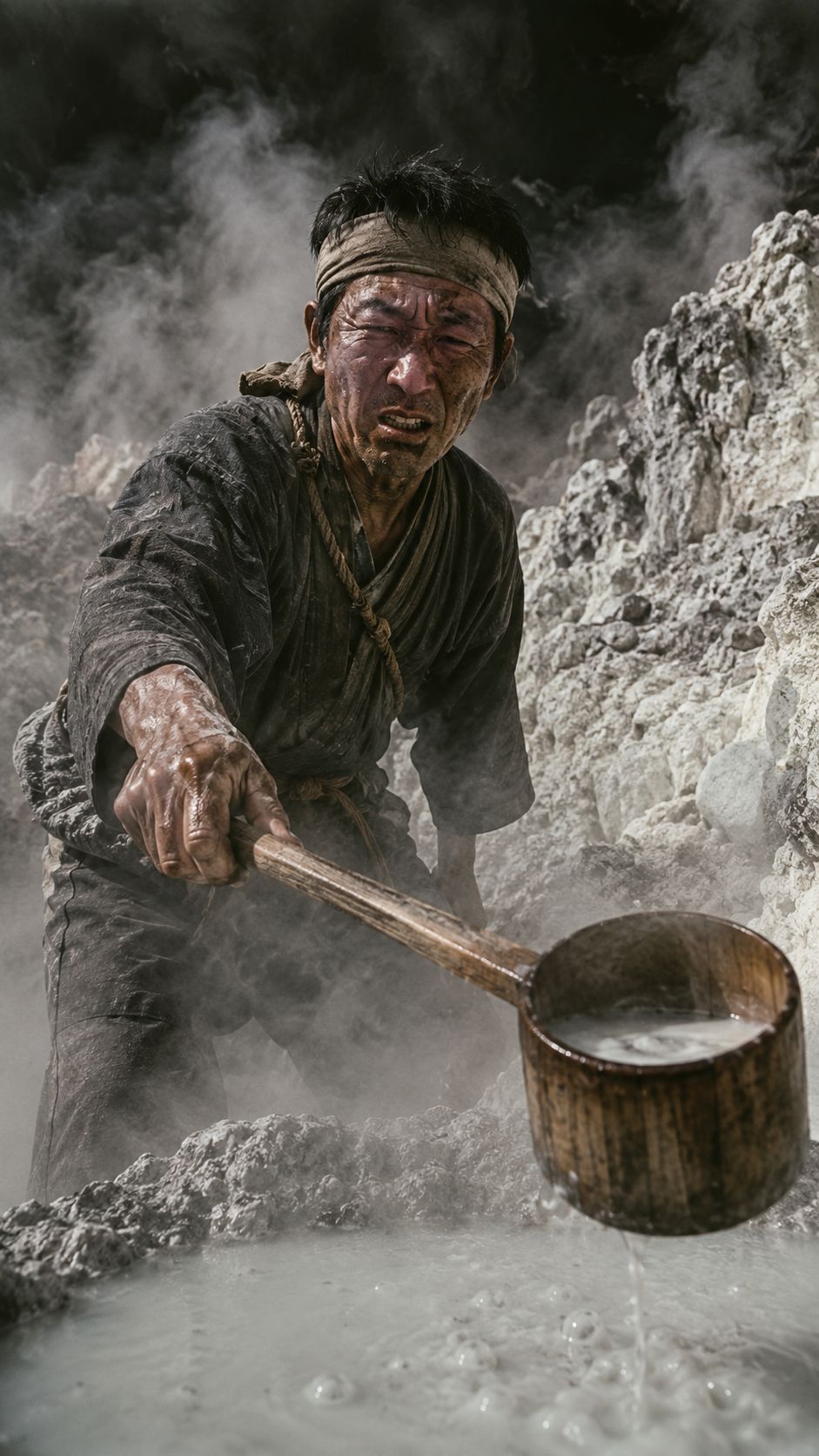 Boiled Alive on Unzen's Sulfur Mountain
Christians who refused to trample a holy image were stripped and doused with boiling spring water on a steaming mountain.
Unzen, Japan · 1630 · 2498 km away
More like this
- The Diplomat Hanged As A Traitor And Honoured As A Saint
The man who exposed Congo's atrocities was hanged for treason, then given a hero's state funeral decades later.
Pentonville Prison, London, United Kingdom · 1916
- The Real Survival Story Behind The Revenant
Mauled by a bear and left for dead, a frontier trapper crawled across hundreds of miles of wilderness to survive.
Shadehill, South Dakota, United States · 1823
 The Rape Trial That Ended In Trial By Combat
A woman's accusation of rape led to France's last judicial duel, with her own life staked on the outcome.
Paris, France · 1386
- The Parish Registers Of The Beast's Victims
Between 1764 and 1767 something killed roughly a hundred people, recorded in the registers as 'devoured by the beast.'
Saugues, France · 1764